Tuesday, February 6

Finally Featuring Louis Slobodkin

Ian McKenzie guessed correctly that last week's mystery artist was Louis Slobodkin, illustrator of one of my favorite children's books, The Hundred Dresses by Eleanor Estes. Before Louis was an illustrator of children's books, he was a sculptor, and you saw a couple of his sculptures in the two mystery artist posts. The one of young Abe Lincoln was done for the 1939 New York Worlds Fair, but it was never exhibited there.
. . . when the Slobodkins arrived at the Fair on opening day to inspect the installation, they were informed by a doorman: "'Taint here any more." The shocking word quickly went round that workmen had demolished the statue on order of Theodore Hayes, Executive Assistant to the Federal Commissioner for the World's Fair, Edward Flynn. Five days later, Slobodkin told The New York Times that, according to a source in Washington, his sculpture had indeed been set upon with sledgehammers, reportedly because a lady who "lunched with Flynn" had not found it to be in "good taste."
It's hard for me to imagine, looking back from my vantage point close to 70 years later, what it was about Slobodkin's young Abe that the woman found not in "good taste". What could it be? That it was a little exaggerated, and not entirely realistic? I feel a little better knowing that the destruction of the Rail Joiner caused plenty of controversy, even drawing Eleanor Roosevelt, who was disheartened by what happened to the statue, into the fray.

Not long after this incident, Louis Slobodkin met Eleanor Estes, who was able to persuade him to illustrate her children's book The Moffats, and he went on to illustrate two more books on the Moffat family. Don't the pictures in the Moffat books (example on the left) look as if they were done by a sculptor?

Another book illustrated by Louis--the one for which he was awarded a Caldecott Medal, and a favorite of many--is James Thurber's Many Moons, the story of the little princess who wants the moon.

However, Louis Slobodkin didn't just illustrate other people's books; he illustrated 50 that he wrote himself. One of my favorites of those he wrote is Hustle and Bustle, the story of two hippos in the zoo.

They were very good friends—

VERY, VERY, VERY GOOD FRIENDS!

Until the day it became obvious to everyone that the friendship ended.

When I did the series of mystery artist posts last year, I wanted to feature Louis Slobodkin, but couldn't find much about him on the internet. I knew he'd been a sculptor, but there just weren't any photos of his work. So imagine how happy I was to recieve an email from Carol Reid, pointing me to her new website featuring Louis Slobodkin. Just about everything there is to know about Louis is there all in one place, including all the information and the quotes in this post. You'll find the sculptures, the children's books, The New Yorker cartoons, and much more.

This is one of Louis Slobodkin's cartoons in The New Yorker. Can't read the caption? Put your cursor over the cartoon or click for the larger version. What do you think? I'd say it might be a good thing he concentrated most on his children's books.

Labels: ,

|

Thursday, February 1

Another Piece By The Mystery Artist

Yesterday I posted a photo of a bronze bust done by a classic children's author-illustrator, and challenged you to guess which illustrator created the piece. No one guessed correctly, so I'm adding another piece, another sculpture, this one of the young Abe Lincoln. This reminds me more of this artist's illustrations in children's books, so perhaps you will find it more helpful for identifying the artist.

This sculpture was created for exhibit at the New York World's Fair. There are at least a couple of other clues for you in the photo.

You can also click on the photo for a larger version of it, if you think that will help. And googling is within the rules of the game, although I can't promise you'll find that helpful.


Update: Ian McKenzie has guessed correctly, much to the disappointment of candyinsierras, who succeeded in googling the answer, only to find that Ian beat her to it. You'll have to read the comments to find the answer. Watch for a short post on the life of this illustrator as soon as I can manage it, and a link to a new website featuring his work.

Labels: ,

|

Wednesday, January 31

Reprising the Mystery Artist Game

Do you remember it? We played it last year with three children's book author-illustrators: Wanda Gag, Virginia Lee Burton and William Steig.

It's time to play again. This time, too, our mystery artist has written and illustrated children's books; although with this particular artist, you may be most familiar with books illustrated for other authors.

Here's a bronze bust sculpted by our mystery artist. Can you guess which children's book illustrator created this?


As always, if you can't guess from this piece, there will be more examples of this artist's work posted later to give you a few more clues.

Labels: ,

|

Tuesday, June 6

William Steig, The Late and Latest Mystery Artist

As usual, it was Island Sparrow who identified the latest mystery children's author/illustrator as William Steig. What can we say, but that the lady from P.E.I. really knows her illustrators?

William Steig was one of my children's favorite picture book authors, but they knew him mostly for Sylvester and the Magic Pebble, Dr.DeSoto, Abel's Island and others of his older books. My kids grew up before the days of Shrek, made famous by the movie, which is probably the way children today know him best.

The very best part of William Steig's picture books are his quirky drawings, but no picture book gets by on drawings alone. The story has to be good, too, and William Steig's stories are the perfect match for his drawings: eccentric, a little silly, but heroic and philosophical, too, told in language that is literary, sophisticated, yet full of good humour. There's no dumbing down for children in William Steig's books!

His whimsical books for children were serious business to William Steig. In his Sylvester and the Magic Pebble Caldecott Award acceptance speech he says that
[a]rt, including juvenile literature, ...helps us to know life in a way that still keeps before us the mystery of things. It enhances the sense of wonder. And wonder is respect for life. Art also stimulates the adventurousness and the playfulness that keep us moving in a lively way and that lead us to useful discovery.
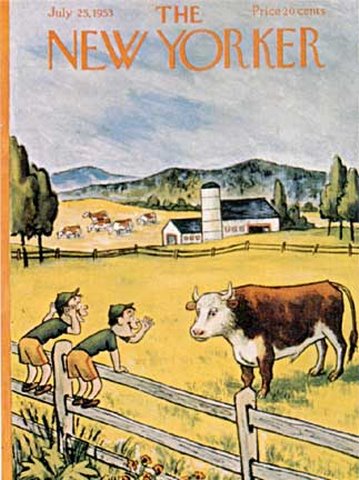
Steig didn't start out doing children's books. He started out as an artist, and what he called "just drawing" was always what he liked best. But an artist has to make money, and Steig made his money as a cartoonist, most notably as a cartoonist for The New Yorker, where he was the magazine's longest-running contributor, with over one hundred cover illustrations and more than one thousand cartoons attributed to him by the time of his death in 2003 at the age of 96. His cartoons from The New Yorker are copyrighted, so I can't post one, but you can check out Man in a Deep Depression or Woman to Cat for an idea of what they were like. On the right is his The New Yorker cover from July of 1953.

Steig supplemented his income from The New Yorker by doing other illustrating work, including making greeting cards. He claimed that he was the pioneer of the contemporary humourous greeting card--the first one to do anything other than sickeningly sweet and mushy Victorian type cards. He also did work drawing advertising cartoons, something that he didn't enjoy much, and that ended abruptly when he told the advertising firm he was dealing with that they were "a bunch of idiots."

But their loss is our gain, since it was partly his lost advertising income that made the invitation to try his hand at making children's books so intriguing to him. A colleague at The New Yorker, Robert Krause, was publishing children's books, and invited Steig to do one, so at sixty years old, he tried his hand at something new. The result was C B D!, a letter puzzle book, then Roland the Minstrel Pig, the book that started the storybook ball rolling, and the rest are children's literature history: Sylvester and the Magic Pebble, Amos and Boris, Caleb and Kate, Yellow and Pink, Brave Irene and many more.

Here's another Steig cartoon:


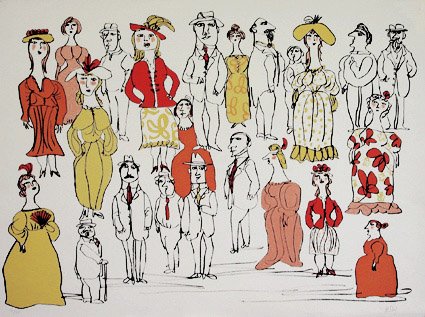
Another The New Yorker cover, this one from 1968:


And a couple of his "just drawings":

Family Reunion


Red Ball

When asked about his recipe for success in children's books, Steig said,
I enjoyed my childhood.... I like to think that I've kept a little innocence. Probably I'm too dumb to do anything else.
Naah. He underestimates himself, don't you think?

Technorati Tags: , , ,

Labels: ,

|

Thursday, May 11

Mystery Artist Again

Hmmm....no one has even tried guessing who the latest mystery artist is, so I'm posting another of this artist's pieces to give you more to go on.

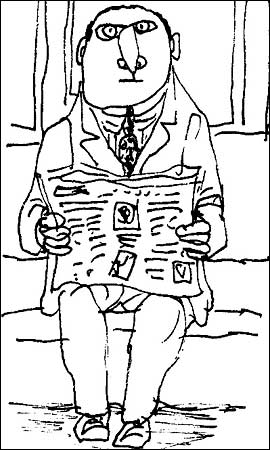
This one is called Subway Rider in a Staring Duel. You can click on the image for a larger view.

And it's a cartoon. Knowing that might help you.

Update: Once again, Islandsparrow is the first to identify the mystery artist. See her answer in the comments.

Tags: , ,

Labels: ,

|

Wednesday, May 10

Another Mystery Artist

Who will be the first to guess whose piece this drawing is? Like all the other mystery artists, this one is done by a well-know children's author-illustrator.

Tags: , ,

Labels: ,

|

Thursday, April 27

Virginia Lee Burton, Artist at Home

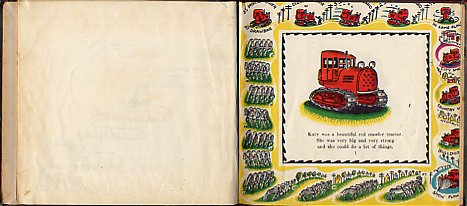
At the beginning of April, I posted a picture of a piece of artwork done by a well-known children's book author/illustrator, and asked you to guess who the artist was. Island Sparrow guessed correctly that the artist was Virginia Lee Burton, the creator of those wonderful machinery heroines (and yes, they were girls!) like Mary Anne, the obsolete steam shovel who finds a new line of work in Mike Mulligan and His Steam Shovel, and Katy the determined little tractor in Katy and the Big Snow.

Virginia Lee Burton is the name she published her children's books under, but that was really just her maiden name. More officially, and in her works other than the children's books, she was Virginia Lee Demetrios, wife of George Demetrios, and mother of the two little boys for whom she was creating books.

Her life and work has several remarkable similarities to Wanda Gag's life and work (Do you remember, Wanda? She was our first mystery artist.), starting with the turn her life took because of difficult circumstances in her family. Wanda Gag had to give up some of her dreams to support her family after her father died; and Virginia Lee Burton wanted to be a dancer, and had just signed a contract to be in her sister's dance troupe, when her father broke his leg. She chose to stay home and look after him instead of travelling as a dancer. That, she said, "was the beginning and end of my dancing career, which was just as well, because I wasn't very good anyway."

While at home in Boston, she took a job as a "sketcher" for the Boston Transcript, making sketches of dancers and actors to accompany articles written by the drama and music critic. It was in Boston that she enrolled in a drawing class taught by George Demetrios, an art teacher who had come highly recommended to her; and after only a few months, she and George Demetrios were married.

Once she had her two sons, Virginia Lee Demetrios became interested in producing books for children. She tested both the stories and the drawings on her own children, and adjusted things (or not) depending on their reactions to them. "Children," she said, "are very frank critics." And excellent ones, too, judging by the quality of the finished work her collaboration with her sons produced.

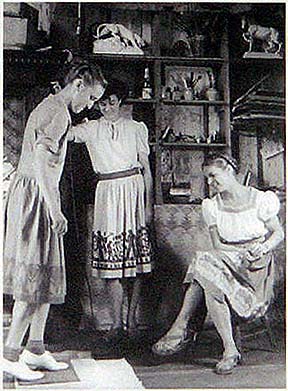
When her sons grew out of the picture book stage, Virginia Lee moved on to another project--teaching design to people in Folly Cove (an area of Gloucester, Massachusetts) where her home was. Her design class evolved into a cooperative group of designers called Folly Cove Designer, whose works consisted of linoleum block prints stamped onto fabric used to make clothing and items for the home. Products from the Folly Cove Designers, headed by Virginia Lee Demetrios, were eventually sold throughout the United States in the 1950s. The piece shown in the mystery artist post linked above is one of the Folly Cove designs done by Virginia Lee, a fabric print called Fish Story; and the photo to the left is a picture of three of the Folly Cove designers dressed in dresses made from linoleum print bordered Folly Cove fabrics. That's Virginia Lee Demetrios sitting on the right of the photo.

In another parallel to Wanda Gag's life, Virginia Lee Demetrios died of lung cancer when she was in her fifties, too. That was the end of Folly Cove Designers, although various museums still feature works from the design cooperative.

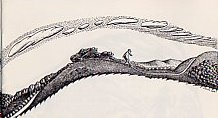
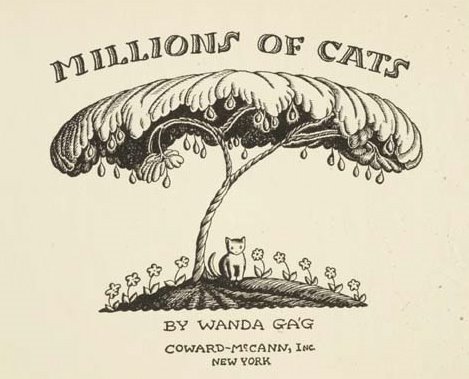
I can't help thinking that there is a similarity in the drawings and prints of the two women as well: the roundness of the hills that featured prominantly in their children's book illustrations, and their trees and cats. On the left, for example, is an illustration from Virginia Lee Burton's The Little House, which was her Caldecott Medal winner. Compare that, especially the circular hills, with the Wanda Gag's illustration from Millions of Cats on the right.

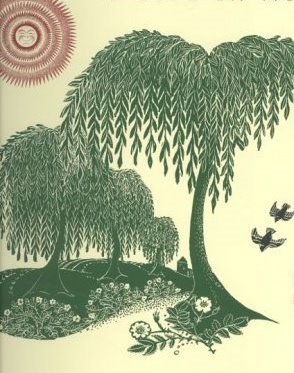
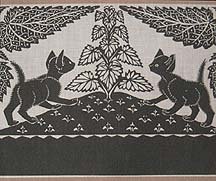
And remember Wanda Gag's tree with little cat from the cover page of Millions of Cats? This is one of Virginia Lee Burton's trees, and below it is a Folly Cove placemat featuring two of her cats.


Yes, the similarities between the two women are striking, but there's at least one noteworthy difference. Wanda Gag, if you remember, fabricated world travelling adventures and prestigious awards in a story of her life that she wrote just before her death. It would seem that she wanted more than her circumstances gave her. Virginia Lee Demetrios, on the other hand, seemed perfectly content to focus her life and her work around her family and community, and saw in her life's circumstances perfect opportunities for expression.

For good measure, here are a few more examples of her work.

This is a design for a tablecloth called A Rose is a Rose. The tablecloth would have been part of the Folly Cove Designers line of housewares.


This is a full page spread from Katy and the Big Snow. Katy was modeled after one of the tractors used by the city of Gloucester at the time the book was written.

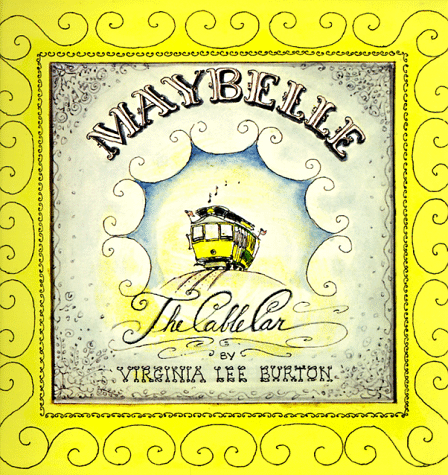
Last, we have the cover of Maybelle the Cable Car, featuring another of Virginia Lee Burton's machinery heroines.

If you still have young children, I hope you are reading them some of Virginia Lee Burton's picture books, along with other classic picture books, too, like those of Wanda Gag. They may not be as flashy as some of the more recently produced children's books, but they've proven themselves popular through a few generations of children, and are part of our collective children's literature heritage. Besides, they'll like them. I promise.

Tags: , , , , ,

Labels: ,

|

Tuesday, April 4

Who Is the Artist?


This is another piece of art work done by a famous author and illustrator of children's books. Can you guess who it is?

Fish Story is a linoleum block print on fabric, done in 1957. If you think you need a better look, click on the photo for a larger view.

Update: Island Sparrow was the only one brave enough to venture a guess, and she was right. The mystery artist is Virginia Lee Burton--you know, author illustrator of such beloved children's books as Mike Mulligan and His Steam Shovel, The Little House, and more. I'll do a short biographical sketch of Virginia Demetrios (she published her children's books under her maiden name) with more pictures, too, when I have time to put it all together.

Tags: , ,

Labels: ,

|

Friday, March 17

Wanda Gag, Free to Imagine

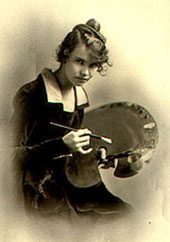
Thanks to Ian, who was the first to guess correctly (although others did, too), I can post this revealing piece by our mystery artist. If you haven't read this book to your kids, you've neglected them.

It's the first children's book, according to my children's literature professor, that used a repeated refrain throughout. (You know it, right?: "...hundreds of cats, thousands of cats, millions and billions and trillions of cats!") It was a technique used in oral versions of folk tales, but it hadn't made its way into books before Wanda Gag* wrote this one. This book was also the first children's book to use a double-paged spread and hand lettered text.

People thought of Wanda Gag as a "free spirit", and her work is very unique and innovative, but she was hardly free. She was the oldest of seven children, and a Minnesota native, as Ian mentioned. She was only fourteen when her father died of tuberculosis, and his last words to her were "what Papa has left undone, Wanda will have to do."

It was her hard work that kept the family together, as she took on odd jobs illustrating magazine articles, greeting cards, and calendars to make money. She graduated high school in 1912, but didn't feel free to accept her scholarship to art school until the next two sisters had graduated high school, too, and were established as teachers.

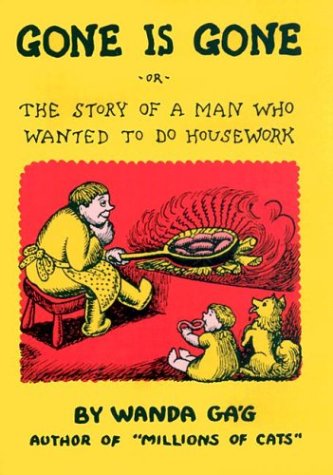
Wanda Gag was a well-known artist with works in the permanent collections of many museums when Millions of Cats was published in 1928. Her other Newberry winning children's book is The ABC Bunny, but you might also be familiar with Gone is Gone (my favorite), Nothing at All and others.

Unfortunately, Wanda died from lung cancer in 1946 when she was only 53. Not long before she died, she wrote a brief autobiography for Illustrators of Children’s Books, 1744-1945 by Bertha Mahoney. Wanda wrote in this piece about serving in the army, living in Paris, and travelling to the Orient and India on a Guggenheim Fellowship.

It was probably what she wished were true, but none of it was. To the last, I guess, Wanda Gag was free spirit, but a free spirit chained by her circumstances.

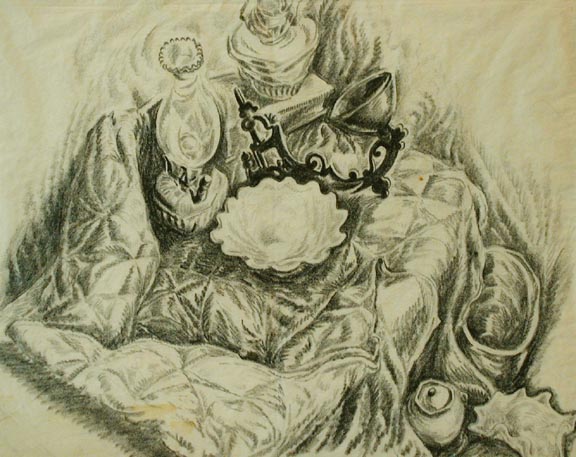
Want to see more of her work, which, by the way, are mostly lithographs?

Still Life

Grandma's Parlor

Spinning Wheel


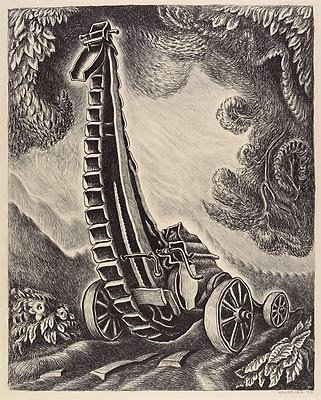
I don't know the title to this last one, but I'm including it anyway, because I really like it. It's a hay baling thingamajig, I think, but the name escapes me. [Update: Island Sparrow's husband thinks that might be a potato harvester. I really should learn not to venture guesses in farm machinery identification.]

*pronounced "Gog", and there's an accent on the a that I can't do.

Tags: , , , ,

Labels: ,

|

Who Is the Artist? More....


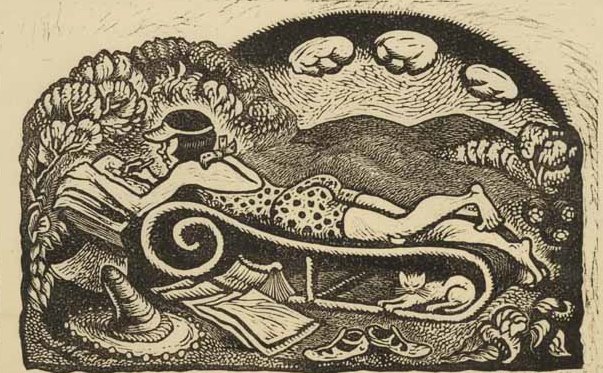
No one guessed correctly on yesterday's post, so here's another work by the same artist. This one is Self Portrait.

Missmellifluous asks "Did the artist write the books or just - well not just - illustrate?" In the books I'm thinking of--the most famous ones--the artist is both author and illustrator.

(Still clueless? You'll find a couple of hints in the comments.)

Tags:

Labels: ,

|

Thursday, March 16

Who Is the Artist?

This piece is called The Forge, and it's in the National Gallery of Art collection. You can click for a larger view.

You may not need to know much about art or artists to make a reasonable guess as to whose work this is. If you have children and you've read the classic children's picture books to them, you're probably familiar with some of this artist's work. If you aren't, then you missed at least one of the most important classics.

Give us your guess in the comments. If no one gets it right--although I'm pretty sure someone will--I'll add a self-portrait that gives some more clues. Right now, the distinctive style is your best hint.

Tags:

Labels: ,

|