Sunday, April 30

Crazy Quilt

Sometime today this blog will have it's 100,000th visitor. Mostly, I try to ignore the numbers on Sitemeter, but 100,000 gets a little attention.

Youngest son will be going to the national competition in his volleyball division in Abbotsford, BC, this week. He's a setter, and a pretty good one, I've been told.

I was reading James White's blog this week, and in one of the posts he gave a little review of the debate he had in Missouri last weekend, linking to a newpaper article reporting on the debate. The article mentions a man named Joe Rostollan (who says, by the way, that Dr. White was the better debater, and that Rev. Wright seemed out of his league), and I recognized the name. It turns out Joe pastors a church in Harrisonville, Mo., but that's not how I know him. I went to the same small Bible college as Joe--Oak Hills Christian College in Bemidji, MN--only back then he looked a lot more like Gabe Kaplan in Welcome Back Kotter than the man in the photo on the church website.

And not long ago, I was watching a DVD called The History and Theology of Calvinism, and one of the experts interviewed looked awfully familiar. It turns out it was Roger Schultz, another man I knew a little from his association with the same school. It seems that Roger is Professor and Chair of the History Department at Liberty University, and also pastor of Westminster Reformed Presbyterian Church. If you've been following some of the stuff coming out of Liberty University in regards to Calvinism lately, you'll understand why I find this amusing.

If you like that sort of irony, it may amuse you to know that another former student and professor at the same little christian college is Dr. John Sanders, who is one of the more well-known open theists.

(My father was also a faculty member at Oak Hills. He's now retired, but you can see him in the bottom photo on this page. He's the fifth man from the right, or the third from the right on the front row.)

I'm still working on organizing old posts into their rightful pigeonholes. Done lately:

Math, Numbers, Puzzles, Etc.
Church Documents, Creed, and Confessions
Assorted Theological
|

Sunday's Hymn: Musical Theme

Oh How I Love Jesus

There is a Name I love to hear,
I love to sing its worth;
It sounds like music in my ear,
The sweetest Name on earth.

Refrain
O how I love Jesus,
O how I love Jesus,
O how I love Jesus,
Because He first loved me!


It tells me of a Savior’s love,
Who died to set me free;
It tells me of His precious blood,
The sinner’s perfect plea.

It tells me of a Father’s smile
Beaming upon His child;
It cheers me through this little while,
Through desert, waste, and wild.

It tells me what my Father hath
In store for every day,
And though I tread a darksome path,
Yields sunshine all the way.

It tells of One whose loving heart
Can feel my deepest woe;
Who in each sorrow bears
A part that none can bear below.

It bids my trembling heart rejoice.
It dries each rising tear.
It tells me, in a “still small voice,”
To trust and never fear.

Jesus, the Name I love so well,
The Name I love to hear:
No saint on earth its worth can tell,
No heart conceive how dear.

This Name shall shed its fragrance still
Along this thorny road,
Shall sweetly smooth the rugged hill
That leads me up to God.

And there with all the blood-bought throng,
From sin and sorrow free,
I’ll sing the new eternal song
Of Jesus’ love for me.

---Frederick Whitfield (Listen)
Other hymns, worship songs, etc. posted this Sunday:If you've posted a hymn or worship song, etc this Sunday, why not let me know in the comments below and I'll add your post to the list above?
Tags: ,
|

Saturday, April 29

Wherein consists the sinfulness of that estate whereinto man fell?

The sinfulness of that estate whereinto man fell, consisteth in the guilt of Adam's first sin,[1] the want of that righteousness wherein he was created, and the corruption of his nature, whereby he is utterly indisposed, disabled, and made opposite unto all that is spiritually good, and wholly inclined to all evil, and that continually;[2] which is commonly called Original Sin, and from which do proceed all actual transgressions.[3]
  1. Rom. 5:12, 19
    Therefore, just as sin came into the world through one man, and death through sin, and so death spread to all men because all sinned...

    For as by the one man's disobedience the many were made sinners, so by the one man's obedience the many will be made righteous.

  2. Rom. 3:10-19
    ...as it is written:

    "None is righteous, no, not one;
    no one understands;
    no one seeks for God.
    All have turned aside; together they have become worthless;
    no one does good,
    not even one."
    "Their throat is an open grave;
    they use their tongues to deceive."
    "The venom of asps is under their lips."
    "Their mouth is full of curses and bitterness."
    "Their feet are swift to shed blood;
    in their paths are ruin and misery,
    and the way of peace they have not known."
    "There is no fear of God before their eyes."

    Now we know that whatever the law says it speaks to those who are under the law, so that every mouth may be stopped, and the whole world may be held accountable to God.

    Romans 5:6
    For while we were still weak, at the right time Christ died for the ungodly.

    Romans 8:7-8
    For the mind that is set on the flesh is hostile to God, for it does not submit to God's law; indeed, it cannot. Those who are in the flesh cannot please God.

    Eph. 2:1-3
    And you were dead in the trespasses and sins in which you once walked, following the course of this world, following the prince of the power of the air, the spirit that is now at work in the sons of disobedience--among whom we all once lived in the passions of our flesh, carrying out the desires of the body and the mind, and were by nature children of wrath, like the rest of mankind.

    Gen. 6:5
    The Lord saw that the wickedness of man was great in the earth, and that every intention of the thoughts of his heart was only evil continually.

  3. James 1:14-15
    But each person is tempted when he is lured and enticed by his own desire. Then desire when it has conceived gives birth to sin, and sin when it is fully grown brings forth death.

    Matt. 15:19
    For out of the heart come evil thoughts, murder, adultery, sexual immorality, theft, false witness, slander.

Question 25, Westminster Larger Catechism.

Tags: , , , , , ,
|

Friday, April 28

Round the Sphere Again

About the Christian Carnival
  • This week's Christian Carnival is up at Brain Cramps for God.

  • Here's a little news from Dory, the Christian Carnival overseer, about the Christian Carnival email list:
    The email list for the Christian Carnival has been down, as you may have noticed, and I have gotten no replies to my requests for help about it. I have therefore started a new list through Google Groups. It should work much the same way. Once you join, you can post to the group by sending an email to this address: ChristianCarnival@googlegroups.com. Posts will be sent to your email address unless you change your settings to read at the web site only. The web site is here: http://groups.google.com/group/ChristianCarnival

    To join, go to the web site and sign up. For a time, I will allow anyone to join and, to prevent spam, limit postings by requiring my approval. After the initial rush of memberships has died down, I will require my approval for membership, but allow any member to post. Please limit posts to hosting announcements only.
    If you haven't signed up already, go sign up right now before you forget!
On a New Web Site for Readers and Others
Tim Challies is announcing the launch of a new web site--The Discerning Reader--which will have all the reviews from his old reader's web site, The Diet of Bookworms, plus much, much more, like
  • reviews of book on the New York Times best seller list
  • lists of books from various experts
  • starter lists for those interested in beginning to read about a new topic
  • mini-reviews suitable for placement in church bulletins
  • bookworm reviews (like the reviews that were previously at the Diet of Bookworms)
Hop on over there and check things out.
Of Things Theological
On the Gospel

About Women's Roles in the Church
Andreas Kostenburger writes on women deacons at his Biblical Foundations blog.

Tags: , , , , , , , , , ,
|

Thursday, April 27

Virginia Lee Burton, Artist at Home

At the beginning of April, I posted a picture of a piece of artwork done by a well-known children's book author/illustrator, and asked you to guess who the artist was. Island Sparrow guessed correctly that the artist was Virginia Lee Burton, the creator of those wonderful machinery heroines (and yes, they were girls!) like Mary Anne, the obsolete steam shovel who finds a new line of work in Mike Mulligan and His Steam Shovel, and Katy the determined little tractor in Katy and the Big Snow.

Virginia Lee Burton is the name she published her children's books under, but that was really just her maiden name. More officially, and in her works other than the children's books, she was Virginia Lee Demetrios, wife of George Demetrios, and mother of the two little boys for whom she was creating books.

Her life and work has several remarkable similarities to Wanda Gag's life and work (Do you remember, Wanda? She was our first mystery artist.), starting with the turn her life took because of difficult circumstances in her family. Wanda Gag had to give up some of her dreams to support her family after her father died; and Virginia Lee Burton wanted to be a dancer, and had just signed a contract to be in her sister's dance troupe, when her father broke his leg. She chose to stay home and look after him instead of travelling as a dancer. That, she said, "was the beginning and end of my dancing career, which was just as well, because I wasn't very good anyway."

While at home in Boston, she took a job as a "sketcher" for the Boston Transcript, making sketches of dancers and actors to accompany articles written by the drama and music critic. It was in Boston that she enrolled in a drawing class taught by George Demetrios, an art teacher who had come highly recommended to her; and after only a few months, she and George Demetrios were married.

Once she had her two sons, Virginia Lee Demetrios became interested in producing books for children. She tested both the stories and the drawings on her own children, and adjusted things (or not) depending on their reactions to them. "Children," she said, "are very frank critics." And excellent ones, too, judging by the quality of the finished work her collaboration with her sons produced.

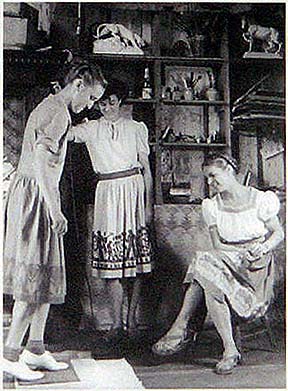
When her sons grew out of the picture book stage, Virginia Lee moved on to another project--teaching design to people in Folly Cove (an area of Gloucester, Massachusetts) where her home was. Her design class evolved into a cooperative group of designers called Folly Cove Designer, whose works consisted of linoleum block prints stamped onto fabric used to make clothing and items for the home. Products from the Folly Cove Designers, headed by Virginia Lee Demetrios, were eventually sold throughout the United States in the 1950s. The piece shown in the mystery artist post linked above is one of the Folly Cove designs done by Virginia Lee, a fabric print called Fish Story; and the photo to the left is a picture of three of the Folly Cove designers dressed in dresses made from linoleum print bordered Folly Cove fabrics. That's Virginia Lee Demetrios sitting on the right of the photo.

In another parallel to Wanda Gag's life, Virginia Lee Demetrios died of lung cancer when she was in her fifties, too. That was the end of Folly Cove Designers, although various museums still feature works from the design cooperative.

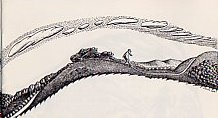
I can't help thinking that there is a similarity in the drawings and prints of the two women as well: the roundness of the hills that featured prominantly in their children's book illustrations, and their trees and cats. On the left, for example, is an illustration from Virginia Lee Burton's The Little House, which was her Caldecott Medal winner. Compare that, especially the circular hills, with the Wanda Gag's illustration from Millions of Cats on the right.

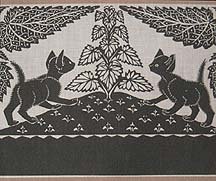
And remember Wanda Gag's tree with little cat from the cover page of Millions of Cats? This is one of Virginia Lee Burton's trees, and below it is a Folly Cove placemat featuring two of her cats.


Yes, the similarities between the two women are striking, but there's at least one noteworthy difference. Wanda Gag, if you remember, fabricated world travelling adventures and prestigious awards in a story of her life that she wrote just before her death. It would seem that she wanted more than her circumstances gave her. Virginia Lee Demetrios, on the other hand, seemed perfectly content to focus her life and her work around her family and community, and saw in her life's circumstances perfect opportunities for expression.

For good measure, here are a few more examples of her work.

This is a design for a tablecloth called A Rose is a Rose. The tablecloth would have been part of the Folly Cove Designers line of housewares.


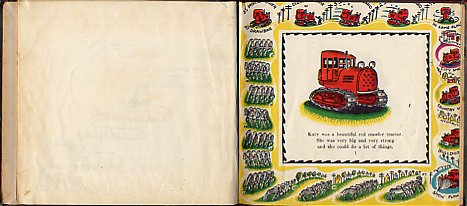
This is a full page spread from Katy and the Big Snow. Katy was modeled after one of the tractors used by the city of Gloucester at the time the book was written.

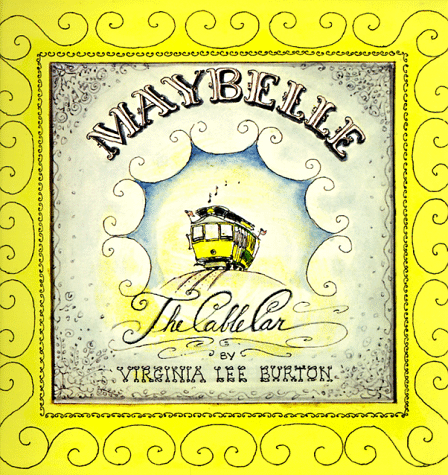
Last, we have the cover of Maybelle the Cable Car, featuring another of Virginia Lee Burton's machinery heroines.

If you still have young children, I hope you are reading them some of Virginia Lee Burton's picture books, along with other classic picture books, too, like those of Wanda Gag. They may not be as flashy as some of the more recently produced children's books, but they've proven themselves popular through a few generations of children, and are part of our collective children's literature heritage. Besides, they'll like them. I promise.

Tags: , , , , ,

Labels: ,

|

Wednesday, April 26

What is sin?

Sin is any want of conformity unto, or transgression of, any law of God, given as a rule to the reasonable creature.[1]
  1. I John 3:4
    Everyone who makes a practice of sinning also practices lawlessness; sin is lawlessness.

    Gal. 3:10, 12
    For all who rely on works of the law are under a curse; for it is written, “Cursed be everyone who does not abide by all things written in the Book of the Law, and do them.”

    But the law is not of faith, rather “The one who does them shall live by them.”

Question 24, Westminster Larger Catechism.

Tags: , , , ,
|

Tuesday, April 25

My Betty Crocker's Cookbook

Last week Kim of Hireath showed us her Betty Crocker's Cookbook. Here's mine. Don't they look similar? She got hers as a wedding shower gift, and mine was either a shower or wedding gift from my former piano teacher.

Our favorite recipe from the book is the Strawberry-filled Roll, which is a variation of the Jelly Roll. Making the roll itself is simpler in this recipe than most, so it tastes great and makes even a beginning cook look like an expert in the kitchen. Conveniently, April is a good season for strawberries in the supermarket, too. Here's the recipe:
  • 3 eggs
  • 1 cup granulated sugar
  • 1/3 cup water
  • 1 teaspoon vanilla
  • 3/4 cup all-purpose flour
  • 1 teaspoon baking powder
  • 1/4 teaspoon salt
Heat oven to 375F. Line jelly roll pan, 15 1/2 by 10 1/2 by 1 inch, with aluminum foil or waxed paper*; grease.

In small mixer bowl, beat eggs about 5 minutes or until very thick and lemon colored. Pour eggs into large mixer bowl; gradually beat in granulated sugar. On low speed, blend in water and vanilla. Gradually add flour, baking powder and salt, beating just until batter is smooth.

Pour into pan, spreading batter to corners. Bake 12 to 15 minutes or until wooden pick inserted in center comes out clean.

Loosen cake from edges of pan; invert on towel sprinkled with confectioners' sugar (icing sugar for Canadians!). Carefully remove foil; trim off stiff edges if necessary.

While hot, roll cake and towel from narrow end. Cool on wire rack. About 1 hour before serving, unroll cake; remove towel.

Beat 1/2 cup chilled whipping cream and 2 tablespoons confectioners' sugar in chilled bowl until stiff. Spread on unrolled cake. Arrange 2 cups sliced fresh strawberries over whipped cream. Roll up; sprinkle with confectioner' sugar. Chill. Serve with sweetened whipped cream.

Eight to 10 servings.

*I prefer wax paper; I find it easier to remove.

Tags: , , , , ,
|

For the Love of Maps

Once in a while, when I'm sorting through my old posts, I find one that I want to tweak or play with a bit. This is one of those, and now I'm posting it again. Why do all that editing work, and not post?

I started loving maps when I was quite young. I can remember poring over gas station road maps before I started school. I liked those phone book city maps, too, and often spent hours studying them so I could understand where everything was. I wanted to know how to go to the places I wanted go.

...I took a back way I had memorized from the city map...
Generally speaking, I was an obedient child--the sort a parent could trust to be doing what was expected. There were a couple of times, however, when my map reading obsession fueled my quest for adventure, and I went places I wasn't supposed to go. Once, while walking home from kindergarten, I decided to try walking round that enticing circle of road that rings the central buildings on the Wheaton College campus rather than cutting straight through the campus like I had been taught. Of course, that took quite a bit longer, and when I didn't arrive home from school on time, my worried parents took the car out searching for me. There I was, my mother says, completely unconcerned, walking the long way home as if I knew what I was doing. And I did know what I was doing.

Then, when I was 7 and my sister was 5, I convinced her to accompany me clear across Wheaton to visit some friends of ours. I didn't ask first, because I knew the answer would be "no". So we wouldn't be discovered and our trip cut short, I took a back way I had memorized from the city map. I can't remember for sure whether we actually reached our friends' house or not, but I do remember walking for a very long time. I knew exactly where I was, so I wasn't worried. For my parents, I'm sure, it was a different story. The odd thing, though, is that I don't remember getting into any trouble over this. I guess my parents were so relieved to have found us that thoughts of punishment were forgotten.

....I think of them in their place on the map I have in my head...
All that practice made me an accomplished map reader, so that by the time I was in first grade, I was helping my mom navigate the city by running into phone booths to check the maps for directions whenever we got lost. When I started reading books, the books I loved most were books with a map for tracing the story--maps of the Hundred Acre Wood, or Archenland, or Middle Earth. If a book didn't have a map, I would sometimes draw one that worked. I drew my own imaginary maps, too, of my own imaginary cities and countries and national parks.

I've never stopped loving maps. I think in maps, and when I think of people, I think of them in their place on the map I have in my head. That's how I catagorize people, I guess, even people who live two blocks over from me. If someone lives halfway round the world, then I think of them in their area of the globe. If I don't know someone's place, then I can't put them in that concrete spot that makes them not just a disembodied spirit, but real person.

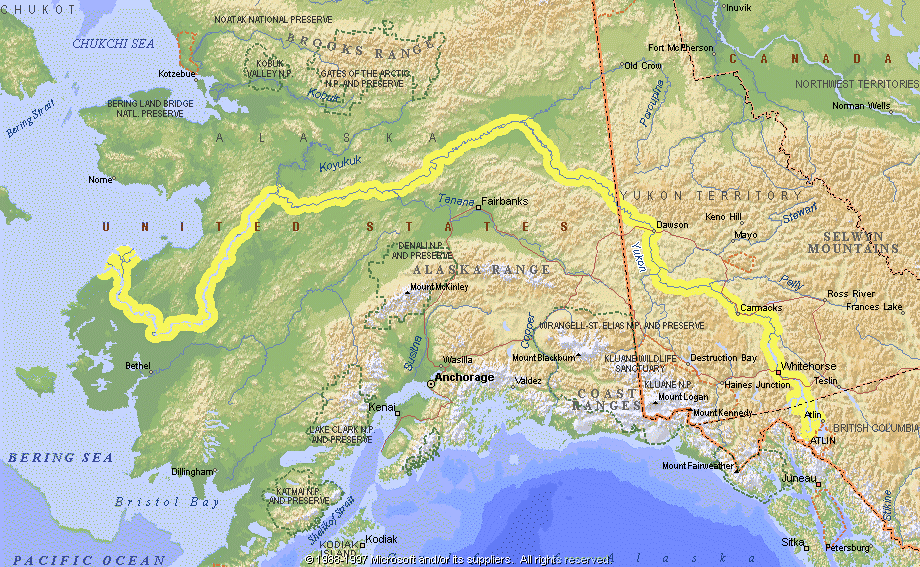
Here's a map of my place. It's a too small to see well, but you can always click on it for the larger view. Somewhere in that little black dot labled Whitehorse is my house.

The highlighted yellow line is the Yukon River, which brings me to another reason that maps are so much fun: They tell you all kinds of interesting things. You'll notice that all the run-off from around my house (and I have lots of it this year!) goes into the Yukon River, and then up and out to the west coast of Alaska into the Bering Sea. I'm only a hundred miles from the coast, but the mountains in between make the long way--1300 miles or so across Alaska to the Bering Sea--the easy way out for the water in my ditch.

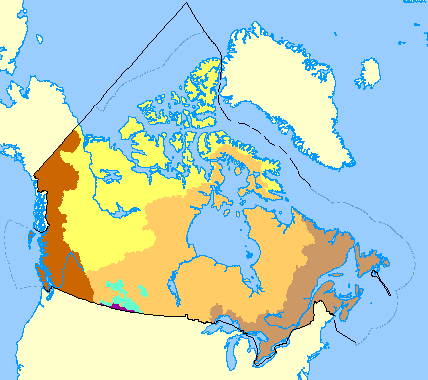
And while we're on the subject of water drainage and maps, here's a little map of the fresh water drainage of all of Canada. The yellow and gold portions, which together make up 75% of Canadian land, drain north into the Arctic Ocean or Hudson Bay. The two brownish sections on either side drain into the Pacific and Atlantic Oceans. (See how the majority of Yukon water drains into the Pacific Ocean, and only a small section goes north to the Artic Ocean?) The tiny purple area on the border of Saskatchewan, Alberta and the U.S. drains out the Missouri River, into the Mississippi, and down to the Gulf of Mexico.

That land locked aqua section? Officially, that section has what's called internal drainage, but I prefer to think of it as draining into rivers that go nowhere. It sounds so much more mysterious that way.

Or we can have fun with maps by matching them with photos. Here's a map of the glaciers and icefields of Canada. Here's a photo of one of those glaciers and/or icefields (one of the ones up on the B.C./Yukon border) taken by oldest son.

There is at least one person who loves maps more than I do. He has a whole blog devoted to them. It's called The Map Room, and you'll find all the latest maps and map news there.

As long as you've come this far, why don't you leave a comment and give me a general idea of your place, so I can pinpoint you on the map in my mind? No specifics necessary; a state or country is enough. The last time I did this, some smart alecks gave me their GPS coordinates. That does nothing for me. I don't have a GPS system in my mind--just a map. So, if you must give your GPS coordinates, please give a place name as well, and I'll be happier.

Tags: ,
|

Monday, April 24

David Brainerd's Birthday

I caught the entries up to date at David Brainerd's Blog this morning. On April 20 (1747) David celebrated his 29th birthday.
Was in a very disordered state, and kept my bed most of the day. I enjoyed a little more comfort than in several of the preceding days. This day I arrived at the age of twenty-nine years.
In his next entry, he makes his final departure from New Jersey. David has been struggling with what was called consumption then, and what we call tuberculosis now.

Tags: , , ,
|

Bonus Original Sin Answers

Here are the answers to the bonus questions on original sin.

1. This first quote is from John Calvin in Calvin's Institutes, Book 2, Chapter 1, Section 5, and is affirming the doctrine of original sin.
Surely there is no ambiguity in David's confession, "I was shapen in iniquity; and in sin did my mother conceive me," (Psa 51: 5) His object in the passage is not to throw blame on his parents; but the better to commend the goodness of God towards him, he properly reiterates the confession of impurity from his very birth. As it is clear, that there was no peculiarity in David's case, it follows that it is only an instance of the common lot of the whole human race. All of us, therefore, descending from an impure seed, come into the world tainted with the contagion of sin. Nay, before we behold the light of the sun we are in God's sight defiled and polluted. "Who can bring a clean thing out of an unclean? Not one," saysthe Book of Job, (Job 14: 4)
2. This quote I transcribed from Dave Hunt's radio program. In it he is denying the doctrine of original sin, although I'm not convinced he's aware that he did, and he may just be doing a little muddled thinking.
The fact is that they did not sin. They died as babies. It wouldn’t be just to condemn to hell. What are they going to suffer for in hell? What deeds have they done?
It's not in his belief that all babies who die go to heaven that he denies original sin, but rather in his statement that there would be no just reason for God to condemn them because they hadn't actually committed any sins, so they have nothing to be saved from. The doctrine of original sin says that it is not only our own deeds that condemn us, but a sin problem we are born with, so even babies need God's merciful salvation.

3. This is a quote of Robert Brow, who co-authored a book called Unbounded Love: A Good News Theology for the 21st Century, which is a book explaining a model of the way God works that they've worked out. Their model called Creative Love Theism.
The Bible does not say that by sinning Adam was sent to eternal damnation. He was excluded temporarily from the garden till God clothed him with new garments. And the garden is in this world where the Son of God wanted to walk and talk with him. Nor does the Bible tell us that all the billions of people who are Adam's offspring are condemned to eternal punishment unless they hear and make a decision to believe certain things. That can only be deduced from some Bible texts hanging together in a certain kind of model.

....In a model of Creative Love Theism, condemnation is the sense of guilt and shame that makes us hide, as Adam and Eve did, from the Son of God instead of walking joyfully with him. There are then two ways of living one's life in the world: either in Christ, or hiding from him.
In this model, the sin problem that human beings have is reduced from just condemnation for sin to a feeling of guilt and shame that cause us to hide from God. Robert Brow and Clark Pinnock set their Creative Love Theism model in contrast to what they call an Original Sin model.

4. I transcribed this quote from a lecture given by John Murray. The ellipses are a spot where John Murray says a few words that are unintelligible, but it's probably just a repetition of a few of the previous words, since Murray tends to do that.
When each member of the human race comes to be in the womb, from the very inception of his or her existence, he and she are involved in that depravity that belongs to the very definition of sin..... And yet, they did not exist when Adam sinned, but nevertheless they are contemplated by God as destined to exist; and consequently, whenever they come to exist, in the providence of God by natural procreation, they come to exist as sinful. They can never be contemplated as anything else.
Here he's explaining the way original sin comes about in each human being.

Tags: , ,
|

Sunday, April 23

Sunday's Hymn: Musical Theme

In My Heart There Rings a Melody

I have a song that Jesus gave me,
It was sent from heaven above;
There never was a sweeter melody,
'Tis a melody of love.

Refrain
In my heart there rings a melody,
There rings a melody with heaven's harmony;
In my heart there rings a melody;
There rings a melody of love!


I love the Christ who died on Calv'ry,
For He washed my sins away;
He put within my heart a melody,
And I know it's there to stay.

'Twill be my endless theme in glory,
With the angels I will sing;
'Twill be a song with glorious harmony,
When the courts of heaven ring.
---Elton M. Roth (Listen)
Other hymns, worship songs, etc. posted this Sunday:
If you've posted a hymn or worship song, etc this Sunday, why not let me know in the comments below and I'll add your post to the list above?
Tags: ,
|

Saturday, April 22

Four in the Top Fifteen

As I write this, oldest son has four of the top fifteen pet photos on smugmug.
Tags: ,
|

Bonus Original Sin Questions

As promised, here are quotes from the three people named in Wednesday's Original Sin Quiz but left unquoted. And just for good measure, I've thrown in one more quote from another person. These should be really easy, so let's add another requirement: In addition to naming the person whose quote it is, you need to decided whether the quote is affirming or denying original sin. The three leftovers are John Murray, Robert Brow (the co-author with Clark Pinnock of a book of theology), and John Calvin; the addition to the list is Dave Hunt.

Go forth and earn some bonus points!

____________ 1
. Surely there is no ambiguity in David's confession, "I was shapen in iniquity; and in sin did my mother conceive me," (Psa 51: 5) His object in the passage is not to throw blame on his parents; but the better to commend the goodness of God towards him, he properly reiterates the confession of impurity from his very birth. As it is clear, that there was no peculiarity in David's case, it follows that it is only an instance of the common lot of the whole human race. All of us, therefore, descending from an impure seed, come into the world tainted with the contagion of sin. Nay, before we behold the light of the sun we are in God's sight defiled and polluted. "Who can bring a clean thing out of an unclean? Not one," says the Book of Job, (Job 14: 4)

____________ 2. This quote was spoken as a strong objection to someone who suggested that since babies who die cannot be believers, then they all go to heaven based on God's choice to save babies who die:

The fact is that they did not sin. They died as babies. It wouldn’t be just to condemn to hell. What are they going to suffer for in hell? What deeds have they done?

____________ 3. The Bible does not say that by sinning Adam was sent to eternal damnation. He was excluded temporarily from the garden till God clothed him with new garments. And the garden is in this world where the Son of God wanted to walk and talk with him. Nor does the Bible tell us that all the billions of people who are Adam's offspring are condemned to eternal punishment unless they hear and make a decision to believe certain things. That can only be deduced from some Bible texts hanging together in a certain kind of model.

....In a model of Creative Love Theism, condemnation is the sense of guilt and shame that makes us hide, as Adam and Eve did, from the Son of God instead of walking joyfully with him. There are then two ways of living one's life in the world: either in Christ, or hiding from him.

____________ 4
. When each member of the human race comes to be in the womb, from the very inception of his or her existence, he and she are involved in that depravity that belongs to the very definition of sin..... And yet, they did not exist when Adam sinned, but nevertheless they are contemplated by God as destined to exist; and consequently, whenever they come to exist, in the providence of God by natural procreation, they come to exist as sinful. They can never be contemplated as anything else.

Tags: , ,
|

Friday, April 21

Round the Sphere Again

This week's Christian Carnival is posted over at Attention Span. Guess what? I actually got my act together and entered this week, and I intend to do that more often.

Other good reading:
  • Fellow Yukoner and friend Scott Gilbreath has an excellent post on Christianity and politics. When you've finished reading, why not do as he suggests and contact your elected representative about the genocide in Darfur?
    I don't think it's very far-fetched to believe that this is something Jesus wants his people to do. Nor, therefore, would it be far-fetched to believe that Jesus would be pleased if some politicians - or political parties - took up the cause of alleviating suffering in Darfur.
    For Canadians, here's a handy little form for finding contact info for your very own Member of Parliament by typing in your postal code.

  • Tim Challies has posted on the benefits of catechisms.
    There is no substitute for investing in children when they are still young. The catechisms that have survived to this day and have stood the test of time are worth knowing. They are worth teaching to our children. They are worth teaching to ourselves.
    I assume you already know that I love the catechisms!

  • Scott McClare gives us a bit of his personal history with the KJV-only cult, along with the reasons he thinks they are getting more and more irrational over time. And yes, cult is exactly the right word to use for the sort of rabid KJV-onlyism he's talking about.
In Bible study news:

Eric Svendsen is back blogging at Real Clear Theology Blog. His
focus going forward will be on the exegetical teaching of the New Testament. In fact, the series will be titled New Testament Reflections, and each sub-series will be an exegetical look at a particular book of the New Testament. Stay tuned for the first of these, Reflections on Philippians.
He promises that the series on Philippians will start next week. Meanwhile, he has posted some foundational steps you can take to make the most of Bible study. This is pretty close to my own Bible study method, except I also like to find out how key words are used, especially by the author of the book being studied. (I recently found some of my own old interpretive paraphrases of Philippians, and I may post them, along with my notes giving my reasons for my paraphrase choices, just for fun.)

Browser suggestion:

Don't tell me you're still using Internet Explorer? I know you are because I see you on my Sitemeter! Why not download Firefox and view the webworld as it really is?

On the lighter side:

How's this for an innovative Yukon business venture?

Tags: , , , , , , , ,
|

Into what estate did the fall bring mankind?

The fall brought mankind into an estate of sin and misery.[1]
  1. Rom. 3:23
    ...for all have sinned and fall short of the glory of God...
    Rom. 5:12
    Therefore, just as sin came into the world through one man, and death through sin, and so death spread to all men because all sinned...

Question 23, Westminster Larger Catechism.

Tags: , ,
|

Thursday, April 20

Quiz Key

As promised, here are the answers to the Quiz on Original Sin posted yesterday. If you haven't tried the quiz itself, why not click over there and see what you know before you read this? I can tell by the comments that there is at least one person who probably scored 100%. How did you do?

Questions 1-3, Multiple Choice

1. The term original sin, as traditionally defined, refers to
a. The very first disobedience of Adam and Eve in the Garden of Eden.
b. The sinful nature that all humankind is born with.
c. A cutting-edge or particularly unique expression of disobedience to God's law.
d. None of the above.
The correct answer is b. Historically, you'll find that some people include both inherited guilt and inherited corruption together as original sin, while some use the term to refer specifically to our inherited corruption (or our sinful nature), so I've included only inherited corruption in the answer, since everyone would agree on that. Except, perhaps, Robert Schuller.

As to the incorrect responses, you might think a. sounds reasonable, but the word origin as used in original sin doesn't mean "first" so much as it means "existing from our beginning". And as for c.? If you answered c., I'm really curious to know the sinful act you think hasn't been done over and over again already. No, I take that back. On second thought, I'd really rather not know.

2. The doctrine of original sin includes the principle that
a. Back in the beginning, Adam represented the whole of humankind.
b. All of humankind fell along with Adam in his first sin.
c. Adam's sin is imputed to all humankind, and everyone suffers the consequences.
d. All of the above.
The correct answer is d. The doctrine of original sin includes all those things. Those of us who hold to the doctrine of original sin may disagree as to exactly how it is that Adam represents us, but we all agree that he did represent us; and as a result of that, we all fell with him when he fell. We are born in a fallen state, since, in some way, Adam's sin was counted as our sin, and thus we suffer the consequences of Adam's fall.

3. That human beings are born with a sinful nature means that
a. All human beings are are bad as the could possibly be.
b. We become sinners only when we actually commit our first sin.
c. Even infants who die need to have Christ's death applied to them.
d. All of the above.
The correct answer is c. That we are born with a sinful nature means that even newborn babies, who have not yet actually committed sin, have a problem within their nature that needs fixing before they can be in the presence of God, who is holy. That "nature problem" can only be fixed as a result of God's merciful application of Christ's death.

As for the wrong answer? That we have a sinful nature doesn't mean we are all as bad as we could be (a.), but it does mean that in respect to God and God's standard, we all have a problem of mammoth proportions. That we have a sinful nature means exactly the opposite of answer b.: It means we are sinners before we commit our first sin, and that we are already sinners is the root of that first sin.

Questions 4-10, Identifying Quotes

4. "We deny that the human constitution is morally depraved, because it is impossible that sin should be a quality of the substance of soul or body. It is, and must be, a quality of choice or intention, and not of substance. To make sin an attribute or quality of substance is contrary to God's definition of sin.

....To represent the constitution as sinful, is to represent God, who is the author of the constitution, as the author of sin."

This quote is from Charles Finney in his Systematic Theology. As you can tell from this quote, Charles Finney denied the doctrine of original sin. He believed that we all come into this world in the same state as Adam and Eve were before the fall.

5. "...all who deny this, call it original sin, or by any other title, are but Heathens still, in the fundamental point which differences Heathenism from Christianity. They may, indeed, allow, that men have many vices; that some are born with us; and that, consequently, we are not born altogether so wise or so virtuous as we should be; there being few that will roundly affirm, "We are born with as much propensity to good as to evil, and that every man is, by nature, as virtuous and wise as Adam was at his creation." But here is the shibboleth: Is man by nature filled with all manner of evil? Is he void of all good? Is he wholly fallen? Is his soul totally corrupted? Or, to come back to the text, is "every imagination of the thoughts of his heart only evil continually?" Allow this, and you are so far a Christian. Deny it, and you are but an Heathen still."

This quote is Charles Wesley's, from one of his sermons. You'll notice that he's calling anyone who doesn't believe in original sin a Heathen. Wesley saw the doctrine of original sin as one of the essential teachings of Christianity.

6. "When a descendent of Adam reaches a level of moral understanding (sometime in his youth) he becomes fully, personally accountable to God and has sin imputed to him, resulting in the peril of eternal damnation.

When man reaches his state of moral accountability, and, by virtue of his personal transgression, becomes blameworthy, his only hope is a work of grace by God alone."

These quotes are from Michael Pearl's No Greater Joy Ministries doctrinal statement. (Don't know who Michael Pearl is? He's known for his parenting advice, and he is very popular in some Christian circles.) As you can see, he denies original sin: No one becomes "blameworthy" until they commit their first personal transgression, and no "work of grace" is necessary until then. So, if I understand these statements correctly, babies go to heaven by virtue of their blamelessness, not because of God's mercy.

7. "The Scriptures as I see it speak of different kinds of sin. The first kind is the corrupt, sinful nature, namely, the lust or desire of our flesh contrary to God's Law, and contrary to the original righteousness; sin which is inherited at birth by all descendants and children of corrupt, sinful Adam, and is not inaptly called original sin. Of this sin David says, Behold, I was shapen in iniquity; and in sin did my mother conceive me. The Lord said unto Noah, The imagination of man's heart is evil from his youth. Again, Paul says, We were, by nature, children of wrath, even as others."

This quote is from Menno Simons, who was a leader of the Anabaptists way back in the 1500's. (Mennonites are named after him.) In this quote from Reply to False Accusations, 1552 (which I only have in PDF form, so no link!), he strongly affirms the doctrine of original sin, although I've read that there are other quotes from Menno Simons that would seem to deny it.

One commenter asked why I included Menno Simons in the list of quotes. I regularly attended attended Mennonite churches during two periods of my life, and I have Mennonite relatives (albeit distant), so I have an interest in Mennonite history.


8. "Some ground the idea of the eternal blessedness of the infant upon its innocence. We do no such thing; we believe that the infant fell in the first Adam, 'for in Adam all died.' All Adam's posterity, whether infant or adult, were represented by him - he stood for them all, and when he fell, he fell for them all. There was no exception made at all in the covenant of works made with Adam as to infants dying; and inasmuch as they were included in Adam, though they have not sinned after the similitude of Adam's transgression, they have original guilt. They are 'born in sin and steepen in iniquity; in sin do their mothers conceive them;' so saith David of himself, and (by inference) of the whole human race. If they be saved, we believe it is not because of any natural innocence. They enter heaven by the very same way that we do; they are received in the name of Christ."

This quote is from a sermon by Charles Spurgeon titled Infant Salvation. Spurgeon, of course, believed in the doctrine of original sin, and you can see that in this paragraph. He also believed that all infants who died were saved, but that they were saved, not because of their own blamelessness, but "because they were redeemed by the precious blood of Jesus Christ."

9. "The core of original sin, then, is LOT -- Lack of Trust. Or, it could be considered an innate inability to adequately value ourselves. Label it a 'negative self-image,' but do not say that the central core of the human soul is wickedness. ...[P]ositive Christianity does not hold to human depravity, but to human inability."

This muddled bit of text is a quote from Robert Schuller in Self-Esteem: The New Reformation. In it he's denying the doctrine of original sin, even though he uses the words original sin. He's just redefined the meaning of original sin in a way that denies the doctrine of original sin as it is commonly defined. We have, according to Robert Schuller, no "core" or seed of corruption--just a lousy self image: We think we're worse than we really are.

10. "I think, it would go far towards directing us to the more clear conception and right statement of this affair, were we steadily to bear this in mind: that God, in every step of his proceeding with Adam, in relation to the covenant or constitution established with him, looked on his posterity as being one with him . And though he dealt more immediately with Adam, it yet was as the head of the whole body, and the root of the whole tree; and in his proceedings with him, he dealt with all the branches, as if they had been then existing in their root.

From which it will follow, that both guilt, or exposedness to punishment, and also depravity of heart, came upon Adam's posterity just as they came upon him, as much as if he and they had all coexisted, like a tree with many branches; allowing only for the difference necessarily resulting from the place Adam stood in, as head or root of the whole."

This is Jonathan Edwards in The Great Christian Doctrine of Original Sin. It is, as you can see, affirming the doctrine of original sin. As you can also see, Jonathan Edwards included both inherited guilt and inherited corruption in his definition of the term original sin.

Chris Datillo asks for quotes from the remaining three unquoted people. Well, I don't have any for Clark Pinnock, but I do have something close. I'll try to post quotes from one of Pinnock's co-authors and the other two unquoted people tomorrow.

Tags: , ,
|

Wednesday, April 19

Quiz on Original Sin


How about a little quiz on the doctrine of original sin?
Choose the answer that best completes the statement.

1. The term original sin, as traditionally defined, refers to
a. The very first disobedience of Adam and Eve in the Garden of Eden.
b. The sinful nature that all humankind is born with.
c. A cutting-edge or particularly unique expression of disobedience to God's law.
d. None of the above.
2. The doctrine of original sin includes the principle that
a. Back in the beginning, Adam represented the whole of humankind.
b. All of humankind fell along with Adam in his first sin.
c. Adam's sin is imputed to all humankind, and everyone suffers the consequences.
d. All of the above.
3. That human beings are born with a sinful nature means that
a. All human beings are are bad as the could possibly be.
b. We become sinners only when we actually commit our first sin.
c. Even infants who die need to have Christ's death applied to them.
d. All of the above.

Match each quote on original sin with the person from the list who said or wrote it.
a. John Wesley
b. John Murray
c. Charles Finney
d. Charles Spurgeon
e. Jonathan Edwards
f. Clark Pinnock
g. Menno Simons
h. Michael Pearl
i. Robert Schuller
j. John Calvin

____ 4. We deny that the human constitution is morally depraved, because it is impossible that sin should be a quality of the substance of soul or body. It is, and must be, a quality of choice or intention, and not of substance. To make sin an attribute or quality of substance is contrary to God's definition of sin.

....To represent the constitution as sinful, is to represent God, who is the author of the constitution, as the author of sin.

____ 5.
...all who deny this, call it original sin, or by any other title, are but Heathens still, in the fundamental point which differences Heathenism from Christianity. They may, indeed, allow, that men have many vices; that some are born with us; and that, consequently, we are not born altogether so wise or so virtuous as we should be; there being few that will roundly affirm, "We are born with as much propensity to good as to evil, and that every man is, by nature, as virtuous and wise as Adam was at his creation." But here is the shibboleth: Is man by nature filled with all manner of evil? Is he void of all good? Is he wholly fallen? Is his soul totally corrupted? Or, to come back to the text, is "every imagination of the thoughts of his heart only evil continually?" Allow this, and you are so far a Christian. Deny it, and you are but an Heathen still.

____ 6. When a descendent of Adam reaches a level of moral understanding (sometime in his youth) he becomes fully, personally accountable to God and has sin imputed to him, resulting in the peril of eternal damnation.

When man reaches his state of moral accountability, and, by virtue of his personal transgression, becomes blameworthy, his only hope is a work of grace by God alone.

____ 7. The Scriptures as I see it speak of different kinds of sin. The first kind is the corrupt, sinful nature, namely, the lust or desire of our flesh contrary to God's Law, and contrary to the original righteousness; sin which is inherited at birth by all descendants and children of corrupt, sinful Adam, and is not inaptly called original sin. Of this sin David says, Behold, I was shapen in iniquity; and in sin did my mother conceive me. The Lord said unto Noah, The imagination of man's heart is evil from his youth. Again, Paul says, We were, by nature, children of wrath, even as others.

____ 8. Some ground the idea of the eternal blessedness of the infant upon its innocence. We do no such thing; we believe that the infant fell in the first Adam, "for in Adam all died." All Adam's posterity, whether infant or adult, were represented by him - he stood for them all, and when he fell, he fell for them all. There was no exception made at all in the covenant of works made with Adam as to infants dying; and inasmuch as they were included in Adam, though they have not sinned after the similitude of Adam's transgression, they have original guilt. They are "born in sin and steepen in iniquity; in sin do their mothers conceive them;" so saith David of himself, and (by inference) of the whole human race. If they be saved, we believe it is not because of any natural innocence. They enter heaven by the very same way that we do; they are received in the name of Christ.

____ 9. The core of original sin, then, is LOT -- Lack of Trust. Or, it could be considered an innate inability to adequately value ourselves. Label it a 'negative self-image,' but do not say that the central core of the human soul is wickedness. ...[P]ositive Christianity does not hold to human depravity, but to human inability.

____ 10. I think, it would go far towards directing us to the more clear conception and right statement of this affair, were we steadily to bear this in mind: that God, in every step of his proceeding with Adam, in relation to the covenant or constitution established with him, looked on his posterity as being one with him . And though he dealt more immediately with Adam, it yet was as the head of the whole body, and the root of the whole tree; and in his proceedings with him, he dealt with all the branches, as if they had been then existing in their root.

From which it will follow, that both guilt, or exposedness to punishment, and also depravity of heart, came upon Adam's posterity just as they came upon him, as much as if he and they had all coexisted, like a tree with many branches; allowing only for the difference necessarily resulting from the place Adam stood in, as head or root of the whole.
Answers will be posted tomorrow. See Quiz Key for answers.

Tags: , ,
|

Tuesday, April 18

Christian Carnival Reminder

Entries for the Christian Carnival are due by tonight (April 18) at midnight EST. Submit your entry to ChristianCarnival [ATT] gmail [DOTT] com. Include
  • The name of your blog
  • The URL of your blog
  • The title of your post
  • The URL of your post
  • A short description of the post
  • The trackback link if you have one
Then look for your entry in tomorrow's (April 19) carnival at Attention Span.

You'll find more complete information on the Christian Carnival here.

Tags: ,
|

I Renounce All Quizzes

....unless they are theologian quizzes. Especially Scottish theologian quizzes. HT to Historia ecclesiastica.


You scored as James Orr. You are James Orr. You are not afraid of Scholarship, but you know that scholarship is not necessarily objective.

James Orr


95%

James Denney


80%

Thomas Boston


60%

Thomas Chalmers


60%

John Knox


55%

Which Scottish Theologian are you?
created with QuizFarm.com


Huh? James who?

Update: There are three articles by James Orr here--numbers 11-13. HT to Kim of Hireath for those.
Tags:
|

'Tis a Gift to be Simple

Especially if you're a meme. I've been tagged by Kim in ON for this one.

Ten of life's simple pleasures:
  1. Puppy breath
  2. A piping hot cup of black coffee
  3. Getting into a bed freshly made up with clean flannel sheets.
  4. Late afternoon sun through the living room windows
  5. Stacking firewood
  6. Running my fingers through a bucket of wild cranberries
  7. The smell of crisp and chilly line dried laundry
  8. Bare feet in wet sand
  9. A thick and heavy dictionary
  10. An American Hershey's plain chocolate bar. And yes, they are different than the Canadian ones--less sweet, and darker.

I'm going to tag Julana for this one. I'm thinking that someone who lives life in the slow lane ought to know something about simple pleasures. I'll tag Andrew, too. If you'd like to do this one as well, consider yourself tagged and say I tagged you.

Update: Andrew has posted his list.

Update 2: Julana's list of simple pleasures is posted, too.

Tags:
|

Monday, April 17

Calendar Girl?

|

Did all mankind fall in that first transgression ?

The covenant being made with Adam as a public person, not for himself only, but for his posterity, all mankind descending from him by ordinary generation,[1] sinned in him, and fell with him in that first transgression.[2]
  1. Acts 17:26
    And he made from one man every nation of mankind to live on all the face of the earth, having determined allotted periods and the boundaries of their dwelling place...

  2. Gen. 2:16-17
    And the Lord God commanded the man, saying, “You may surely eat of every tree of the garden, but of the tree of the knowledge of good and evil you shall not eat, for in the day that you eat of it you shall surely die.”
    Rom. 5:12-20
    Therefore, just as sin came into the world through one man, and death through sin, and so death spread to all men because all sinned - for sin indeed was in the world before the law was given, but sin is not counted where there is no law. Yet death reigned from Adam to Moses, even over those whose sinning was not like the transgression of Adam, who was a type of the one who was to come.

    But the free gift is not like the trespass. For if many died through one man's trespass, much more have the grace of God and the free gift by the grace of that one man Jesus Christ abounded for many. And the free gift is not like the result of that one man's sin. For the judgment following one trespass brought condemnation, but the free gift following many trespasses brought justification. If, because of one man's trespass, death reigned through that one man, much more will those who receive the abundance of grace and the free gift of righteousness reign in life through the one man Jesus Christ.

    Therefore, as one trespass led to condemnation for all men, so one act of righteousness leads to justification and life for all men. For as by the one man's disobedience the many were made sinners, so by the one man's obedience the many will be made righteous. Now the law came in to increase the trespass, but where sin increased, grace abounded all the more,
    I Cor. 15:21-22
    For as by a man came death, by a man has come also the resurrection of the dead. For as in Adam all die, so also in Christ shall all be made alive.
Question 22, Westminster Larger Catechism.

Tags: , ,
|

Sunday, April 16

From Our House to Yours

Easter Greetings!
|

Sunday's Hymn: Easter Sunday

Christ is Risen! Hallelujah!

Christ is risen! Hallelujah!
Risen our victorious Head!
Sing His praises! Hallelujah!
Christ is risen from the dead!
Gratefully our hearts adore Him,
As His light once more appears,
Bowing down in joy before Him,
Rising up from grief and tears,
Christ is risen! Hallelujah!
Risen our victorious Head!
Sing His praises! Hallelujah!
Christ is risen from the dead!

Christ is risen! all the sadness
Of His earthly life is o'er,
Through the open gates of gladness
He returns to life once more;
Death and hell before Him bending,
He doth rise, the Victor now,
Angels on His steps attending,
Glory round His wounded brow.
Christ is risen! all the sadness
Of His earthly life is o'er,
Through the open gates of gladness
He returns to life once more.

Christ is risen! henceforth never
Death or hell shall us enthrall;
We are Christ's, in Him forever
We have triumphed over all;
All the doubting and dejection
Of our trembling hearts have ceased,
'Tis His day of resurrection!
Let us rise and keep the feast.
Christ is risen! henceforth never
Death or hell shall us enthrall;
We are Christ's, in Him forever
We have triumphed over all.

---John S. B. Monsell (Listen)
Other hymns, worship songs, etc. posted this Easter Sunday:
Tags: , ,
|

Saturday, April 15

What the Resurrection Means for Believers

He is risen!
He is risen indeed!


Throughout the Epistles of the New Testament, we are taught the believer's identification with Christ brings them glorious personal benefits. Believers are united with Christ in His death and resurrection, and that union with Christ changes things for us. What gifts does being united with Christ in His resurrection give to us?

Christ's resurrection means that we can be certain that we will be resurrected after we die:
But now Christ has been raised from the dead, the firstfruits of those who have fallen asleep. For since death came through a man, the resurrection of the dead also came through a man. For just as in Adam all die, so also in Christ all will be made alive. But each in his own order: Christ, the firstfruits; then when Christ comes, those who belong to him. (1 Corithians 15:20-23 NET)
In the same way that being included with Adam brought us death, belonging to Christ assures us that we will rise again after we die. Christ's present resurrected life is a promise to those who belong to Him that they will one day be brought with Him into the same resurrected life. The first sheaf of the harvest has already been offered*, and the rest of the fruit will follow on the day Christ returns.

His resurrection included the resurrection of his body, and so will ours. Paul tells us that the sort of body that Christ had when he walked the earth after His resurrection, and with which He ascended and now rules from heaven, is the same sort of body that we will have when we are raised at His coming.
It is the same with the resurrection of the dead. What is sown is perishable, what is raised is imperishable. It is sown in dishonor, it is raised in glory; it is sown in weakness, it is raised in power; it is sown a natural body, it is raised a spiritual body. If there is a natural body, there is also a spiritual body. So also it is written, "The first man, Adam, became a living person"; the last Adam became a life-giving spirit. However, the spiritual did not come first, but the natural, and then the spiritual. The first man is from the earth, made of dust; the second man is from heaven. Like the one made of dust, so too are those made of dust, and like the one from heaven, so too those who are heavenly. And just as we have borne the image of the man of dust, let us also bear the image of the man of heaven. (1 Corinthians 15: 42-49 NET)
Our resurrected body will be a reproduction of the one the man of heaven has. Just as our identification with Adam brought us perishable bodies, our identification with Christ in his resurrected life will bring us imperishable bodies. The mortal will become immortal, so that we can sing along with Paul and Isaiah:
Death has been swallowed up in victory .
Where, O death, is your victory?
Where, O death, is your sting? (1 Corinthians 15:55)
This is the hope we have. We will be raised in incorruptible bodies to live forever with the One who takes us with Him in His resurrection.

Christ's resurrection changes things for us right now in the life we live as believers.

The resurrected life that comes into completeness at our glorification when we receive our resurrected bodies is already within us.
But God, being rich in mercy, because of his great love with which he loved us, even though we were dead in transgressions, made us alive together with Christ--by grace you are saved! and he raised us up with him and seated us with him in the heavenly realms in Christ Jesus.. (Ephesians 2:4-6 NET)
We have been made alive together with Christ and new sort of life has begun within us--a recreated life:
Therefore we have been buried with him through baptism into death, in order that just as Christ was raised from the dead through the glory of the Father, so we too may live a new life. For if we have become united with him in the likeness of his death, we will certainly also be united in the likeness of his resurrection. (Romans 6:4,5 NET)
Our new life is grounded in our association with Christ's resurrection. Because we are in Christ, we are new creation. We have begun our lives in the realm of the resurrection, where sin has no dominion: the old things have passed away, and the new things have come. The changed life we have--the life in the Spirit--comes to us through our inclusion with the risen Christ, and based on this new reality, we are called to live a new kind of life.
Therefore, if you have been raised with Christ, keep seeking the things above, where Christ is, seated at the right hand of God. Keep thinking about things above, not things on the earth, for you have died and your life is hidden with Christ in God. When Christ (who is your life) appears, then you too will be revealed in glory with him. So put to death whatever in your nature belongs to the earth.... (Colossians 3:1-5a NET)
We are urged to put aside the things we once loved and the passions we once followed as the old sort of person we were, for now we have been clothed with the new person--one "that is being renewed in knowledge according to the image of the one who created it (Colossians 3:10)." We must clothe ourselves in the power of the resurrection and live according to the fruit the Spirit produces within us.

As men and women of the new life, we need to "present [ourselves] to God as those who are alive from the dead and [our] members to God as instruments to be used for righteousness (Romans 6:13 NET)." We can do this knowing that there is no reason for sin to defeat us as we work out the victory over sin that has already become reality in Christ's resurrection, a victory that will come to its consummation when we are raised with Him when He comes again.
Christ's resurrection proves to all that He is Lord, and it is through His resurrection that He becomes Lord in truth to those who belong to Him.
*See Leviticus 23 for a full explanation of the firstfruits.
This is a re-editted piece first posted a couple of years ago.
|

What the Resurrection Says to the World

He is risen!
He is risen indeed!

While Jesus Christ's resurrection has special significance for those who believe in him - those who are united to the resurrected Christ through faith - the resurrection also sends a message about Jesus Christ to everyone, believer and unbeliever alike.

The resurrection is evidence that Jesus is the long awaited Promised One.

David prophesied that the Messiah would not see corruption, which the apostle Peter identifies at Pentecost as a prophesy fulfilled by the resurrection of Jesus:
Brothers, I may say to you with confidence about the patriarch David that he both died and was buried, and his tomb is with us to this day. Being therefore a prophet, and knowing that God had sworn with an oath to him that he would set one of his descendants on his throne, he foresaw and spoke about the resurrection of the Christ, that he was not abandoned to Hades, nor did his flesh see corruption. This Jesus God raised up, and of that we all are witnesses. Being therefore exalted at the right hand of God, and having received from the Father the promise of the Holy Spirit, he has poured out this that you yourselves are seeing and hearing. For David did not ascend into the heavens, but he himself says,
The Lord said to my Lord, "Sit at my right hand, until I make your enemies your footstool."
Let all the house of Israel therefore know for certain that God has made him both Lord and Christ, this Jesus whom you crucified. (Acts 2: 29-36 ESV)
It is because Jesus was raised that we can "know for certain that God has made him both Lord and Christ." His resurrection confirms his fulfillment of Messianic prophesy, showing that he is for certain the long awaited Promised One.

The resurrection declares that Jesus is the Son of God in power.

Jesus was born in weakness, and during his earthly ministry and perfect obedience unto death, we see his human frailty, but with the resurrection, a new phase of Jesus' human existence dawned. In his resurrection, Jesus is shown to the world to be the Son of God in power. Paul tells us that he was
...descended from David according to the flesh and was declared to be the Son of God in power according to the Spirit of holiness by his resurrection from the dead, Jesus Christ our Lord... (Romans 1:3,4 ESV)
The resurrection announces to the world that Jesus Christ has been appointed to a position of power and authority.

The resurrection is proof that Jesus has been appointed by God as the Judge of All.

The apostle Paul told the people of Athens that Jesus' resurrection gives assurance to all people everywhere that he is the one whom God has appointed to judge the world:
The times of ignorance God overlooked, but now he commands all people everywhere to repent, because he has fixed a day on which he will judge the world in righteousness by a man whom he has appointed; and of this he has given assurance to all by raising him from the dead. (Acts 17:30, 31 ESV)
We know Jesus Christ is the Judge of All because he has been raised, and the only reasonable response to the surety of this promise of judgment by Christ is repentance.
The Jesus who stands before us is not just another prophet or teacher, and not just a humble servant, but the one whom God has shown to be the Lord of All - the Son of God in power - by his resurrection from the dead. He can stand in judgment over every single person because he has a right to judge, having been appointed to this role by the Father, who has proved once and for all to everyone the certainty of Christ's coming judgment by raising him from the dead.

The resurrection calls all people to respond by turning from rebellion against Christ to confession of the truth of the resurrection: that He has been made Ruler of All and is declared before all as worthy of worship. It is confirmation to all people that
God has highly exalted him and bestowed on him the name that is above every name, so that at the name of Jesus every knee should bow, in heaven and on earth and under the earth, and every tongue confess that Jesus Christ is Lord, to the glory of God the Father. (Philippians 2:9-11 ESV)

This is a re-editted piece first posted a couple of years ago.
|

Friday, April 14

The Agonie

P hilosophers have measur'd mountains,
Fathom'd the depths of seas, of states, and kings,
Walk'd with a staffe to heav'n, and traced fountains:
But there are two vast, spacious things,
The which to measure it doth more behove:
Yet few there are that sound them; Sinne and Love.

Who would know Sinne, let him repair
Unto mount Olivet; there shall he see
A man so wrung with pains, that all his hair,
His skinne, his garments bloudie be.
Sinne is that presse and vice, which forceth pain
To hunt his cruell food through ev'ry vein.

Who knows not Love, let him assay
And taste that juice, which on the crosse a pike
Did set again abroach; then let him say
If ever he did taste the like.
Love in that liquour sweet and most divine,
Which my God feels as bloud; but I, as wine.

---George Herbert


More Good Friday goodness:
Tags: ,
|

Thursday, April 13

Round the Sphere Again

  • This week's Christian Carnival is at Cadmusings.

  • Catez of Allthings2all gives us a peek into Richard Hawkings' book A Brief History of Time and Hawking's own wrestling with the implications of singularity.

  • Did you know that we have the Salvation Army to thank for our red phosphorus matches? Read the story on Ian's Messy Desk.

  • Sean Michael Lucus answers his own question: "What ten books, say, should be considered the canon of great works of theology?" Here's his list.

    Here's John Hendryx's list of theological must-reads as found at Reformation Theology.

    What would your list be?

  • A while ago I linked to my oldest son's letter to the Minister of Defense. Yesterday he received his reply--with real ink signature--and he's posted that on his blog as well.

  • Had enough of the Gospel of Judas? Purgatorio comes to the rescue with the Gospel of Brian.

  • Need a cool (or not-so cool) name for you church? Try these: How to Name Your Suburban Mega-Church in 3 Easy Steps! and Name your own Reformed church! (My son suggests using the name of the nearest local ranch or dog kennel, as in Sky High Wilderness Assembly.)

    Tags: , , , , ,
  • |

    My Ebenezer

    The third hymn wording question in the previous post asking for your hymn questions was raised by Hal: What does Ebenezer mean in Come Thou Fount of Every Blessing?

    That's a word that I don't use every day, and if I do use it, I'm most likely referring to Ebenezer Scrooge! The hymnal that my church uses, if I remember right, removes the word Ebenezer and replaces it with something else--a phrase that I can't remember. The hymnal editors, I suppose, are hoping to clarify a word they assume many will not understand. So what in the world does Ebenezer mean?

    Let me refresh your memory by posting the relevent text from the hymn:
    Here I raise my Ebenezer;
    Hither by Thy help I'm come...
    The word Ebenezer is an allusion to a story in the Old Testament, and if we were more Old Testament literate, understanding that bit of the hymn would be easier for us. You can find the whole story in 1 Samuel 4-7, but the conclusion is that God delivers the Israelites from the Philistines, and in response to this intervention from God on behalf of his people, Samuel places a large stone between Mizpah and Shen.

    What was the purpose of the stone? Let me quote Charlie, who pointed us to a post he'd written on this story.
    [Samuel] publicly dedicated it as a monument to God's help, God's faithfulness, God's eternal covenant.
    The stone was a public memorial to God's help, so Samuel named the stone Ebenezer, which means stone of help.

    When we sing Come Thou Fount we are raising our own Ebenezer. We are reminding ourselves that it is only by God's gracious help that we've been restored to fellowship with him. It is hither by Thy help I'm come, and therefore, I can rest in the security of my future as well. I can hope, by Thy good pleasure, Safely to arrive at home.

    Tags: ,
    |

    Wednesday, April 12

    Such a Worm!

    If you remember, the second question in Monday's post, That's a Good Question, was about a change in the hymn book used at my church to the words of Isaac Watt's hymn Alas! And Did My Saviour Bleed, specifically the removal of the phrase such a worm as I, replacing it with sinners such as I. Since then I've found out that some versions of this song don't even mention sin at all, but have replaced the worm phrase with such a one as I.

    I'd suspected that the motive behind the change might be theological, since the very first time I experienced someone changing these words was in Bible college, when the student leading the singing in the chapel service had us change those particular words because he objected to the picture of humankind that the worm image painted. This particular student was big on self-esteem, and the problems - at least as he saw it - that a lack of self-esteem created in individuals within the Christian community.

    Chris's comment on that first post, with his mention of the term worm theology, helped confirm my suspicion. It was a term that I was unfamiliar with, but a Google search revealed that worm theology is a derogatory term used for Calvinism in general, and the doctrine of total depravity specifically. I found a Missouri Synod Lutheran article bemoaning the removal of any statements referrencing "the 'corrupted-nature' language of Luther and the Formula of Concord" from new Lutheran liturgy. This change, says the author .
    ..was undoubtedly influenced by critiques caricaturing this as "worm theology," but the point of the older liturgies was to acknowledge not only that we have sinned but that we are sinners.
    Chris also notes that our hymnal (Yes, Chris goes to the same church as I do.) is a Mennonite hymal. Conservative Mennonites believe that human beings inherited a tendency toward sin as a result of the fall, but that Christ's death removed the guilt of Adam from the account of every person, so that every person stands justified before God with respect to the guilt of Adam. Therefore, human beings are not born under condemnation, but are only condemned for their personal sin. Babies, according to Mennonite belief, are born with right standing before God, and only lose their standing when they first knowingly do something they shouldn't. So it is possible that the belief that we are all born uncondemned may have played a role in the removal of the phrase such a worm as I from our hymnal.

    Whatever you think of worm theology, you can't get around the fact that the Bible itself uses the image of a worm in reference to human beings in several places, for instance Job 25: 4-6, Isaiah 41:14, and Psalm 22:6. The image isn't used to deny our value as beings made in God's image, but rather to show that in comparison to God, who is righteous, perfect, eternal, and all-powerful, etc, we are like insignificant worms.

    Isaac Watts uses this scriptural image to paint a similar picture in Alas! And Did My Saviour Bleed. In comparison to the infinite value and perfection of the Sacred Head, we are such worms! And yet, in the glorious act of God's Son that we will remember especially on this upcoming Friday, the Sacred Head was devoted - my Sovereign bled and died - for such a worm.

    Tags: , ,
    |

    Tuesday, April 11

    Cloth Napkins


    Perhaps you call them serviettes. Whatever you call them, I spent part of the afternoon making us a new assortment while listening to today's Dividing Line. Some of the fabric I used was given to me by a friend when she cleared out all her fabric scraps before she moved; some of the fabric was from an almost new curtain I picked up at the Salvation Army Thrift Store for twenty-five cents; and I also cheated--at least by my tightwad rules--and picked up 1/2 meter pieces of a couple cute springy prints in the bargain bin at the fabric store.

    We always use cloth napkins. It's been 20 years since I've purchased any paper ones. Cloth napkins work better, cost less, are probably more environmentally friendly, and they look a whole lot prettier, to boot. The ones we were using were at least 10 years old and starting to look faded and warn, and besides, I've gone to a more retro pastel cottage look in the kitchen, so it was time for a fresh set of the right colored napkins.

    You might be wondering if cloth napkins are worth the work. I certainly think so. After all, a set that I can stitch up in an hour or so will last for 10 years. It took longer to photograph them and compose this post than it took to make them! They do have to be washed, but that's hardly enough work to even notice. I just throw the dirty napkins in with other laundry--I figure 10 napkins are equivalent to one T-shirt weight-wise--and then quickly fold them as they come out of the dryer. In the summer I hang them on the line, and even then they need no ironing to look good.

    So how did I make them? First I ripped pieces of 100% cotton fabric into 15 1/2 inch squares. (All-cotton fabric is much better than a polyester/cotton blend. Polyester fibres are stain magnets, and nothing looks worse than dirty looking napkins.) Sixteen or 16 1/2 inches square might have been a better size, but that extra inch would have meant I could only get two napkins crosswise instead of three, and for a tightwad, that's too much of a sacrifice to make.

    Next I turned the edges under 1/4 inch and then 1/4 inch again and hemmed. I hemmed a first side and then the side directly opposite before moving on to the edges perpendicular to it. Hemming in this order gives a nice little square stitching detail on the corners. Each napkin took only a few minutes from start to finish.

    When I'd hemmed them all, I gave them a quick once-over with an iron so the hems would lie flat. Then I folded them up, collected them together, and insisted that everyone in the family admire them, especially if they wanted supper.

    Tags: , ,
    |

    Christian Carnival Reminder

    Entries for the Christian Carnival are due by tonight (April 11) at midnight EST. Submit your entry to ChristianCarnival [ATT] gmail [DOTT] com. Include
    • The name of your blog
    • The URL of your blog
    • The title of your post
    • The URL of your post
    • A short description of the post
    • The trackback link if you have one
    Then look for your entry in tomorrow's (April 12) carnival at Cadmusings.

    You'll find more complete information on the Christian Carnival here.

    Tags: ,
    |

    Sweetest Frame

    I've decided to deal with each of the questions about the wording in hymns in a separate post. The first question was the one that came from a search query that led to this site: What does the word frame mean in the hymn The Solid Rock. The first verse to the hymn goes like this:
    My hope is built on nothing less
    Than Jesus' blood and righteousness.
    I dare not trust the sweetest frame,
    But wholly trust in Jesus' Name.
    Here is a summary of the answers given in response:
    1. The word frame is referring to a "frame of mind". This explanation was tentatively given by me. Kevin gives a similar response:
      If you had a moment, one blissful moment, when you were sure your heart was right toward God, and you could rejoice in the darkest prison before your imminent death, you would have experienced a moment in the sweetest frame.
      So if this response is right, then the idea is that we oughtn't trust in our good feelings toward God, but in Christ himself. According to my dictionary, the word frame was indeed used this way, particularly in the 18th and 19th century, when it was
      used as a disparaging term for emotional states as a criterion of the reality of spiritual life.

    2. Some understand the word to be referring to something undergirding and supporting, like the frame or foundation of a building. From Kim of Hireath:
      I always thought it meant not to trust (build upon) any other foundation except the name of Jesus. Christ is our Solid Rock upon which we built our foundation. So frame, to me means what we are building on the foundation.
      Judy, and Catez had similar ideas. This response has the whole context of the verse going for it. The thought is on building, and a frame as a support for something being built makes sense in that context.


    3. Charlie looked the word frame up in the Oxford English Dictionary, and suggests that an older meaning of the word may be in view. The word once meant "an advantage or benefit".
      So, in this case, it means that my trust isn't placed in any benefit I might conceive of except the cross and the name of Jesus.
      I pulled out my big old OED, and sure enough, the very first definition given is "advantage, benefit, profit" with a quote about the resurrection of Christ being our frame. I suspect that this usage of the word may have been obsolete by the time this hymn was written, however, since the last quoted usage of it in that way is in 1330.


    4. Hal understood frame to refer to another person:
      So I've always taken the hymn to be saying 'I dare not put my trust or faith in any other person no matter how good they look or appear or seem, but upon Christ alone I will trust for everything and everyone else is lesser than He.

    5. Jeff found a variarion on the words to this hymn in the Lutheran Hymnal.
      My hope is built on nothing less
      Than Jesus’ blood and righteous;
      No merit of my own I claim
      But wholly lean on Jesus’ name.
      So, as Jeff says, this may be an "old question" that this revised version of the hymn is attempting to answer.
    Whew! That was fun. As I have time, I'll get to the other questions. Meanwhile, are there any comments on this question and the possible answers to it?

    Tags: , , ,
    |

    Monday, April 10

    Sweetness Defined


    Tags: , , ,
    |

    Sunday, April 9

    That's a Good Question!

    Every once in a while I like to check the search queries that lead people to this blog. Yesterday, besides learning that I am number one out of only six entries returned for a Google search of the phrase "Oh the moon in june is a big balloon", I found an interesting query in the form of a question, and it was a question that I'm not sure I know the answer for. How about you? Can you help?

    Here's the query: hymn "solid rock" - what does frame mean.

    So, as I take it, the questioner is asking what the word frame in the hymn The Solid Rock means. (And by the way, that isn't the real title to that hymn, even though that'd be what I'd call it, too. The absolutely correct title is My Hope is Built. But I'm way off-track!) To put the word in context and jog your memory, here's the first verse of the hymn by Edward Mote:
    My hope is built on nothing less
    Than Jesus' blood and righteousness.
    I dare not trust the sweetest frame,
    But wholly trust in Jesus' Name.
    Need a little more help? Here are the definitions of frame from the online dictionary at die.net. I'd always assumed that frame was poetic shorthand for frame of mind, but I'm not sure that that's the case. What say ye?

    And while we're on the subject, are there any words to hymns that leave you confused as to their meaning? What hymn word or meaning related questions do have? Let's make a list of questions and (hopefully) answers to them.

    As usual, I'll start things off in the list, first with the anonymous question from the search query and then with one of my own.
    1. What is the meaning of the word frame in the hymn The Solid Rock? Update 3: I've posted the possible answers that commenters have given for this question in a separate post.

    2. Yesterday in church we sang Isaac Watt's hymn Alas! And Did My Saviour Bleed? Our hymnal changes the words such a worm as I to sinners such as I. (So does the Cyber Hymnal, but you'll also find the original words noted.) What do you think is the reasoning behind the change? An objection to the theology underlying the original wording? A fear that people wouldn't understand the worm imagery? To keep kids from giggling? Whatever it is, I'm pretty sure I'm against it! Update 4: A discussion of this question is now posted.

    3. Update: Hal brings up the question of the meaning of the word Ebenezer in Come Thou Fount. Update 5: Discussion of this question is posted in My Ebenezer.
    Okay, now it's your turn.

    Update 2: I think I'll make a separate post with the answers (or suggested answers) to each of these questions, since putting the answers in this post would probably make things more confusing. Meanwhile, if you have additional questions, please ask them. The more the merrier, right?

    Tags: ,
    |

    Saturday, April 8

    Sunday's Hymn: Palm Sunday

    Hosanna, Loud Hosanna

    Hosanna, loud hosanna, the little children sang;
    Through pillared court and temple the lovely anthem rang.
    To Jesus, Who had blessed them close folded to His breast,
    The children sang their praises, the simplest and the best.

    From Olivet they followed mid an exultant crowd,
    The victor palm branch waving, and chanting clear and loud.
    The Lord of men and angels rode on in lowly state,
    Nor scorned that little children should on His bidding wait.

    "Hosanna in the highest!" that ancient song we sing,
    For Christ is our Redeemer, the Lord of heaven our King.
    O may we ever praise Him with heart and life and voice,
    And in His blissful presence eternally rejoice!

    ---Jeanette Threlfall (Listen.)
    Other hymns, worship songs, etc. posted this Sunday:
    Tags: , ,
    |

    Round the Sphere Again

  • This week's Christian Carnival is at ...in the outer....

  • Oh Canada: Chez Kneel gives us a brief history of Canadian Conservative politics, and then summarizes a speech he heard Preston Manning give recently. Why do insurance people have all the fun?

  • On the news:
    • In light of this story (which, to be clear, is about a woman who took childrearing advice to physically discipline her children to an extreme), now is a good time to point out Rebecca Prewitt's letter, Avoiding Millstones.
      My purpose in writing this letter is not to argue whether or not spanking has its place in the Christian home. Instead, it is to appeal to those in the Body of Christ who teach and advocate spanking that you would do so responsibly, prayerfully, humbly, fearfully, and in a manner consistent with the whole counsel of God.

    • Both Al Mohler and James White comment on the recent news about the Gospel of Judas:

      From Traitor to Hero? Responding to The Gospel of Judas

      The Gospel of Judas: Nothing New Under the Sun

      It always amuses me when people think they can get something of historical value from the Gnostics!

  • It's all about the music:
  • At Theologica: Arch Van Devender defends the nitpickers:
    ...theological nit-pickers are just as necessary for the advancement of the Gospel as broad-minded, open-hearted, generous evangelists who only want to "tell people about Jesus."

  • And we'll have fun, fun, fun...:

    Fun with the animals:
    Fun with Chaucer: Thanks to gratitude & hoopla, I now know that Geoffry Chaucer Hath a Blog.

    Fun with shoelaces: Shoelaces? Yep, lacing shoes has never been so much fun. And there's a bit of shoelace math, too, and goodness knows, math is always a party.

  • |

    Did man continue in that estate wherein God at first created him?


    Our first parents being left to the freedom of their own will, through the temptation of Satan, transgressed the commandment of God in eating the forbidden fruit; and thereby fell from the estate of innocency wherein they were created.[1]
    1. Gen. 3:6-8
      So when the woman saw that the tree was good for food, and that it was a delight to the eyes, and that the tree was to be desired to make one wise, she took of its fruit and ate, and she also gave some to her husband who was with her, and he ate. Then the eyes of both were opened, and they knew that they were naked. And they sewed fig leaves together and made themselves loincloths.

      And they heard the sound of the Lord God walking in the garden in the cool of the day, and the man and his wife hid themselves from the presence of the Lord God among the trees of the garden.

      Gen 3:13
      Then the Lord God said to the woman, "What is this that you have done?" The woman said, "The serpent deceived me, and I ate."

      Eccl. 7:29
      See, this alone I found, that God made man upright, but they have sought out many schemes.

      II Cor. 11:3
      But I am afraid that as the serpent deceived Eve by his cunning, your thoughts will be led astray from a sincere and pure devotion to Christ.

    Question 21, Westminster Larger Catechism.

    Tags: , , ,
    |

    For My Birthday

    I intended to show you these a long time ago, but it slipped my mind. Kim of Hiraeth made these bookmarks and sent them to me for my birthday. Aren't they great?


    Right now I'm using them in The Message of the New Testament by Mark Dever, and Feminine Appeal by Carolyn Mahaney, two books I'm reading at the same time and should have finished and reviewed shortly. I hope.

    Tags: ,
    |

    Friday, April 7

    Temporality

    tem-po-ral-i-ty
    n. pl. tem-po-ral-i-ties
    1. The condition or quality of being temporal or bounded in time.
    It is Benjamin Franklin who is quoted in that famous statement about the inevitability of death and taxes, "In this world nothing can be said to be certain, except death and taxes." Electric Ben is speaking about the two things he sees as constants in the world we live in, and one of those constant things is that nothing--not even my own life in this world--lasts forever. Everything, in a temporal world, is limited.

    If you were to ask me what the one constant of our temporal world is, I think I'd say it's change. Everything is always changing; nothing ever stays the same. And change invariably brings loss along with it, even when it isn't the oh-so-final loss of the ultimate change that comes with death itself. Loss is there even in the kinds of change that we think of as positive change. Change is moving from one thing to another, and moving always means leaving something behind. When we get married, for instance, we vow to "forsake all others". Making that vow is a positive step--an excellent thing--but it's a step that closes the doors to possibilities and opportunities that existed previously, at least if we do as we've pledged.

    If you are older than twenty, you probably understand this, at least a little. You've lived long enough to have experienced the loss that happens even when we move forward in our lives. And the more life experience we have, the more we're aware of the constancy of change and loss. It's not something we like to think a lot about, because it points to the ever-present insecurity of our lives.

    One of the good things about getting married, to go back to the previous example, is the security it offers. I forsake all others for only one who promises to forsake all others for only me. We promise never to change our allegiances but to "keep me only unto thee", no matter what other circumstances around us change, whether things get better or worse, whether we become richer or poorer, whether we stay healthy or not. The pledge of marriage is a pledge to have unchanging loyalties in a changing world.

    And yet even in marriage, as wonderful and secure as it is, at least compared to the insecurity of many other things in our lives, there is something insecure and temporary written right within the vow we take. The security of the pledge only goes "as long as we both shall live." And as Ben Franklin reminded us, the end of that pledge is one of the certainties of life in a temporal world.

    Temporality automatically brings with it futility. The Preacher of Ecclesiastes understood that:
    Vanity of vanities, says the Preacher,
    vanity of vanities! All is vanity.
    What does man gain by all the toil
    at which he toils under the sun?
    We work hard, and we think we're making progress, but any gains are only temporary. Even the progress made by a whole generation of people working amounts to nothing at all in the end. The earth, says the Preacher, stays the same. The same, that is, in its ever-present cycle of change and loss. The promise of a new day fades into the evening. The promise of spring turns into the harvest of summer, which turns into the rotting of fall and the death of winter.

    Since the Preacher's time, we've had many more generations that simply give reinforcement to his statements. Nothing that we see or hear completely satisfies us; we always long for more and for longer: For permanent newness, for never-ending promise. And we can't have it. We only get the briefest glimpses of newness and promise, but we cannot grasp them and keep them forever for ourselves.

    Not in a temporal world. There is no real hope, but only what is finally futile, in temporality.
    |

    The End of an Era

    Today is the day of the last Red Green Show.

    My husband loved the Red Green Show, and before that we used to watch Smith & Smith, a comedy sketch show Steve Smith did with his wife Morag. After that show, they did a couple other comedy shows together, until Morag decided she needed more time for the children and she retired from active performing.

    What I missed when Morag retired was her giggling at Steve's antics. She obviously understood his humour and loved it.

    Now the remaining Smith is retiring. Not to worry, though. I'm pretty sure there are enough shows to rerun them forever.

    Update: The comments to this post are already becoming a short list of favorite redgreenisms, thanks to Amy and Bugblaster, so let's go with the flow. Contribute your own Red Green sketch or quote to the list.
    • Amy: If the women don't find you handsome, they should at least find you handy.

    • Bugblaster:
      My favourite sketch: Red had a flat tire, and all he had for a spare was one of those little doughnut tires. But he had a long way to travel. Red got out the duct tape, and started to go round and round the outside of the spare, to build up the diameter to the same as a normal tire.

      Then he turned to the camera and said, "This is temporary. Unless it works."

    • Kim in ON reminds us of the Man's Prayer at the end of every show: I'm a man, but I can change, if I have to, I guess.

    • Terry Stauffer gives us one of his favorite sketches:
      My favorite part of the show was the handyman corner, particularly the one where Red made an amphibious car. This is not an exact quote, but if you've seen the episode, this should bring it back: "The reason that these things haven't caught on," Red said, "is that people went about it the wrong way. They started with a car and tried to make a boat out of it ..." Red's solution was to take an aluminum boat on a trailer into a car - with lots of duct tape, of course.

    • Island Sparrow wants to write her own Red Green sketch:
      We made a castle from cardboard refrigerator boxes for a Grade 3 fairy tale theme. I used duct tape but the castle kept coming apart. I ran upstairs to my library and came back with book repair tape (very expensive - I have to hide it or else all my teachers "borrow" it). We retaped the castle with book tape and it stayed together in spite of 28 enthusiastic grade 3 students playing in it.

      Ever since I've wanted to write the show and challenge Red to a tape dual - something like "Librarians vs Handymen".
    Tags: ,
    |

    Thursday, April 6

    A Heads Up

    |

    Wednesday, April 5

    Recently at the Blog

    Island Sparrow correctly identified the mystery artist. When I get time, I want to write a little more about Virginia Demetrios, so that post is on my list of things to do.

    This evening I collected all the George Herbert poems into one pigeonhole. Earlier today I worked on a piece that is turning out to be a bit of a struggle, but I hope to keep working on it until I'm satisfied and I can post it.

    I also need to write on Supralapsarianism for Theologica. And let me tell you, I feel like I've gone head first through the wringer on an old washing machine by the time I've finished one of those Orders of the Eternal Decrees posts. It's one thing to understand them, and a whole other thing to explain them.

    Meanwhile, you can entertain yourself by looking at this bit of panoramic stitching done by oldest son. That's taken from up in the mountains looking down on the city of Whitehorse. If you look carefully, you can see a subdivision (Don't ask me which one!), and what I think is either Lake Laberge (of The Cremation of Sam McGee fame) or the Yukon River.

    Can you also find son's truck?

    Update: You'll find the backstory to this photo here.
    |

    Chance the Muskox Dies

    Last year at this time I posted a couple of posts about the little orphaned muskox brought to the local game farm and his friendship with a young caribou there.

    Unfortunately, Chance died unexpectedly last Friday from what appears to be some sort of liver problem. You can read all the details from a CBC story here.

    Tags: , ,
    |

    Tuesday, April 4

    Who Is the Artist?


    This is another piece of art work done by a famous author and illustrator of children's books. Can you guess who it is?

    Fish Story is a linoleum block print on fabric, done in 1957. If you think you need a better look, click on the photo for a larger view.

    Update: Island Sparrow was the only one brave enough to venture a guess, and she was right. The mystery artist is Virginia Lee Burton--you know, author illustrator of such beloved children's books as Mike Mulligan and His Steam Shovel, The Little House, and more. I'll do a short biographical sketch of Virginia Demetrios (she published her children's books under her maiden name) with more pictures, too, when I have time to put it all together.

    Tags: , ,

    Labels: ,

    |

    Christian Carnival Reminder

    Entries for the Christian Carnival are due by tonight (April 4) at midnight EST. Submit your entry to ChristianCarnival [ATT] gmail [DOTT] com. Include
    • The name of your blog
    • The URL of your blog
    • The title of your post
    • The URL of your post
    • A short description of the post
    • The trackback link if you have one
    Then look for your entry in tomorrow's (April 5) carnival at ...in the outer....

    You'll find more complete information on the Christian Carnival here. Remember the change in policy! From Dory:
    Hosts have the option of limiting the Christian Carnival to the first 40 acceptable entries. Just one more reason for you to enter early!
    Update, April 5: The host of the Christian Carnival sent word out that it will not be posted until this evening.

    Tags: ,
    |

    Putting Pigeons in Their Place

    Along with finally putting a link to Pigeonholes in the sidebar, I added two new categories there:

    The Jesus the Logician Project posts (Explanation of this project here. Main index here.):
    And the Called According to Paul series:

    Update: Added Photos Farther Afield:
    I also added a few more posts to the theological category:
    And more Whitehorse photos, too:
    |

    Monday, April 3

    Called According to Paul: Summary

    This post is a summary of all the posts in the Called According to Paul series. Below you'll find a summary of the way Paul uses the word call or called in regards to God's call, and the things he most often associates with it. An explanation of this series of posts can be found here. You'll find the previous thirteen posts in the series listed under Current Series in the sidebar.

    Places where Paul uses called as a word of divine power--as something that brings certain results. I've also included in this list all the times that the word called is used as a metonymy for saved, since the reasoning seems to be that the call, as the word is used in these cases, always brings salvation. Given how many times Paul clearly uses the word called as a word of divine power, one might reasonably conclude that he always (or usually) uses the word like this, and thus this meaning ought to be understood in his other uses as well. The instances on this list, however, are those times where the power in the call is unmistakeable from the language of the context.

    Places where Paul uses called as a summons or appointment. I consider these to be a subset of the divine power category, since there is forcefulness in the idea of summons or appointment.

    As a summons to apostleship:
    As a summons to holiness, Christlikeness, sainthood, etc.

    Places where Paul has the call originating in God's choice/purpose/will.

    Places where Paul has the call originating in God's love/grace/mercy:

    Places where Paul stresses the insignificance or "nothingness" of who/what is called:

    Places where Paul stresses the personal/individual nature of the call. Included with this list should also be the instances found above where the call is to apostleship:

    There she be. The list isn't infallible, and I haven't checked and double checked, so corrections are welcome.

    Tags: , ,
    |

    Sunday, April 2

    Only in the Yukon: Fish Lake, Early April


    Sons and I drove out to Fish Lake yesterday afternoon. The photographer does not want this photo attributed to him, but it was not snapped by oldest son or I. It is, I think, the best photo out of all the ones we took. (As always, you can click for the big view.)

    Tags: , ,

    Labels:

    |

    Sunday's Hymn: The Nauticals

    They That Traffic On The Sea

    They that traffic on the sea,
    While unceasing watch they keep,
    See Jehovah’s majesty
    And His wonders in the deep;
    For He bids the storm-wind fly,
    Lifting ocean’s waves on high.

    By the billows heav’nward tossed,
    Down to dreadful depths again,
    Troubled much, their courage lost,
    Reeling, they like drunken men
    Find their skill and power o’erthrown;
    None can save but God alone.

    To Jehovah then they cry
    In their trouble, and He saves,
    Drives the darkness from the sky,
    Calms the storm and stills the waves,
    Makes their sad forebodings cease,
    To their haven guides in peace.

    Sons of men, awake to praise
    God the Lord Who reigns above,
    Gracious in His works and ways,
    Wondrous in redeeming love;
    Praise Him where the people meet,
    Praise Him in the elder’s seat.

    ---Paraphrase of Psalm 107, author unknown.
    Other hymns, worship songs, etc. posted this Sunday:
    Know of more? Let me know!
    Tags: , , ,
    |

    Saturday, April 1

    Save Challies!


    It's a new campaign, organized by me. Or so I'm told. Find out why this campaign is important, and how you can help here.

    Update: In response to a question from an anonymous commentor: Leave your pledges in the comments on this post. I'm not good with money.
    |

    What was the providence of God toward man in the estate in which he was created?

    The providence of God toward man in the estate in which he was created, was the placing him in paradise, appointing him to dress it, giving him liberty to eat of the fruit of the earth;[1] putting the creatures under his dominion,[2] and ordaining marriage for his help;[3] affording him communion with himself;[4] instituting the sabbath;[5] entering into a covenant of life with him, upon condition of personal, perfect, and perpetual obedience,[6] of which the tree of life was a pledge;[7] and forbidding to eat of the tree of the knowledge of good and evil, upon the pain of death.[8]
    1. Gen. 2:8
      And the Lord God planted a garden in Eden, in the east, and there he put the man whom he had formed.
      Gen. 2:15-16
      The Lord God took the man and put him in the garden of Eden to work it and keep it. And the Lord God commanded the man, saying, “You may surely eat of every tree of the garden..."
    2. Gen. 1:28
      And God blessed them. And God said to them, “Be fruitful and multiply and fill the earth and subdue it and have dominion over the fish of the sea and over the birds of the heavens and over every living thing that moves on the earth.”
    3. Gen. 2:18
      Then the Lord God said, “It is not good that the man should be alone; I will make him a helper fit for him.”
    4. Gen. 1:26-29
      Then God said, “Let us make man in our image, after our likeness. And let them have dominion over the fish of the sea and over the birds of the heavens and over the livestock and over all the earth and over every creeping thing that creeps on the earth.”

      So God created man in his own image,
      in the image of God he created him;
      male and female he created them.

      And God blessed them. And God said to them, “Be fruitful and multiply and fill the earth and subdue it and have dominion over the fish of the sea and over the birds of the heavens and over every living thing that moves on the earth.” And God said, “Behold, I have given you every plant yielding seed that is on the face of all the earth, and every tree with seed in its fruit. You shall have them for food."

      Genesis 3:8
      And they heard the sound of the Lord God walking in the garden in the cool of the day, and the man and his wife hid themselves from the presence of the Lord God among the trees of the garden.
    5. Gen. 2:3
      So God blessed the seventh day and made it holy, because on it God rested from all his work that he had done in creation.
    6. Gal. 3:12
      But the law is not of faith, rather “The one who does them shall live by them.”
      Rom. 10:5
      For Moses writes about the righteousness that is based on the law, that the person who does the commandments shall live by them.
    7. Gen. 2:9
      And out of the ground the Lord God made to spring up every tree that is pleasant to the sight and good for food. The tree of life was in the midst of the garden, and the tree of the knowledge of good and evil.
    8. Gen. 2:17
      "....but of the tree of the knowledge of good and evil you shall not eat, for in the day that you eat of it you shall surely die."
    Question 20, Westminster Larger Catechism.

    Tags: , , ,
    |