Still Winter After All These Months
 Copyright © 2006-2007, Andrew Stark. All rights reserved.
(click for larger view)
Labels: photos, Yukon life, Yukon wild
posted by Rebecca Stark at 3/02/2007 12:36:00 AM


Copyright © 2006-2007, Andrew Stark. All rights reserved.Labels: photos, Yukon life, Yukon wild
posted by Rebecca Stark at 3/02/2007 12:36:00 AM
Labels: Yukon life, Yukon wild
posted by Rebecca Stark at 1/18/2007 07:30:00 AM
 My husband's father was in the Yukon long before we were. During the construction of the Alaska Highway, he left his wife and a couple of kids behind (Hubby wasn't born yet!) and came way up here for nine months to work construction while the road to Alaska was built. I'd always assumed he's worked in road construction, since he had a construction company with road building equipment, but hubby corrected me several years ago. His dad had done plumbing--his real trade--while he was up here. I asked hubby where he'd done plumbing, and he thought he'd plumbed the new highway camps built as the road went through.
 My husband's father died when he was only 49 and my husband was only 11. I think part of the incentive for my husband taking the teaching job up here was that he would, in a small way, be following in his father's footsteps.* When the sons and I made a trip to Carcross recently, youngest son said, "It's weird to think that Grandpa Stark was once here."
 I don't think Carcross has changed a whole lot since Grandpa was there, either. Here's a photo, taken by oldest son, of the same little church as it looks today. (You can click on the picture for the larger view.) It looks much the same as it did in 1943, except there is an electrical line to the church, a light over the door, and no bell in the steeple. There's also a boardwalk to the church in the old photo that isn't there on the new one. We had a family discussion about whether the windows are newer additions, and we think they are, but we can't be sure.
Labels: Yukon life
posted by Rebecca Stark at 10/22/2006 08:41:00 PM

Labels: Yukon life
posted by Rebecca Stark at 8/08/2006 08:21:00 AM

Labels: Yukon life
posted by Rebecca Stark at 6/26/2006 04:36:00 PM

Labels: Yukon life
posted by Rebecca Stark at 4/02/2006 08:10:00 PM
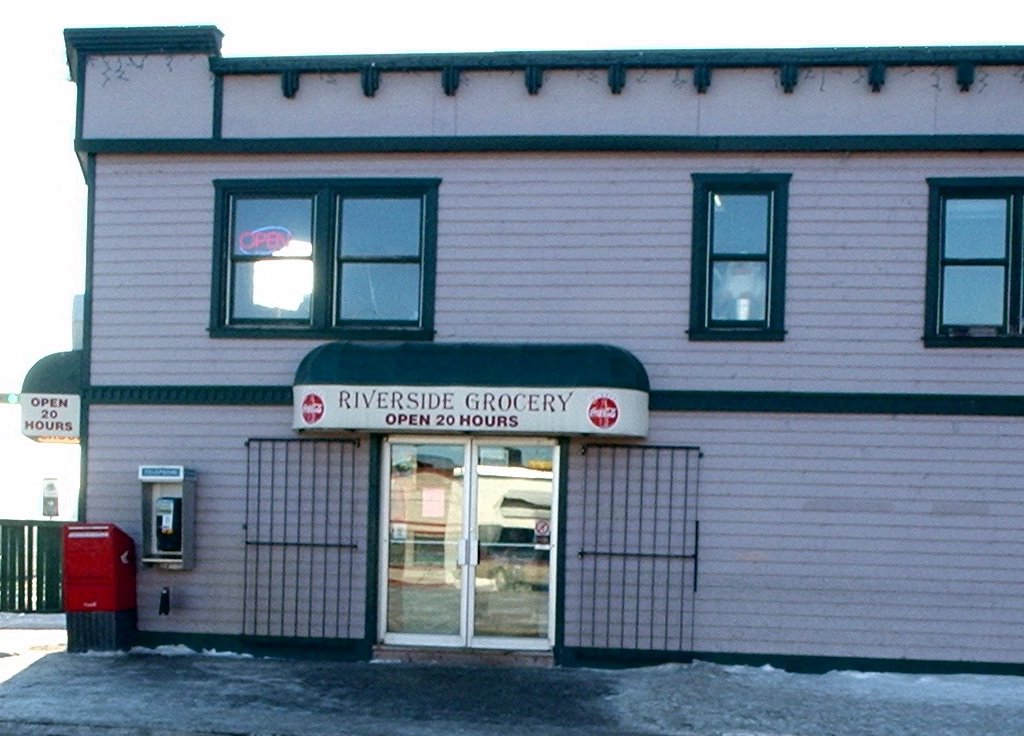 In many ways, Whitehorse is a lot like any other town. We have our big box Walmart and Superstore and Canadian Tire, but we have our little unique places, too. Less than there used to be, since some of the old landmarks, like our quonset hardware store with it's decrepit tilting wood floors, have been torn down to make way for businesses that are more nondescript and less customer friendly.
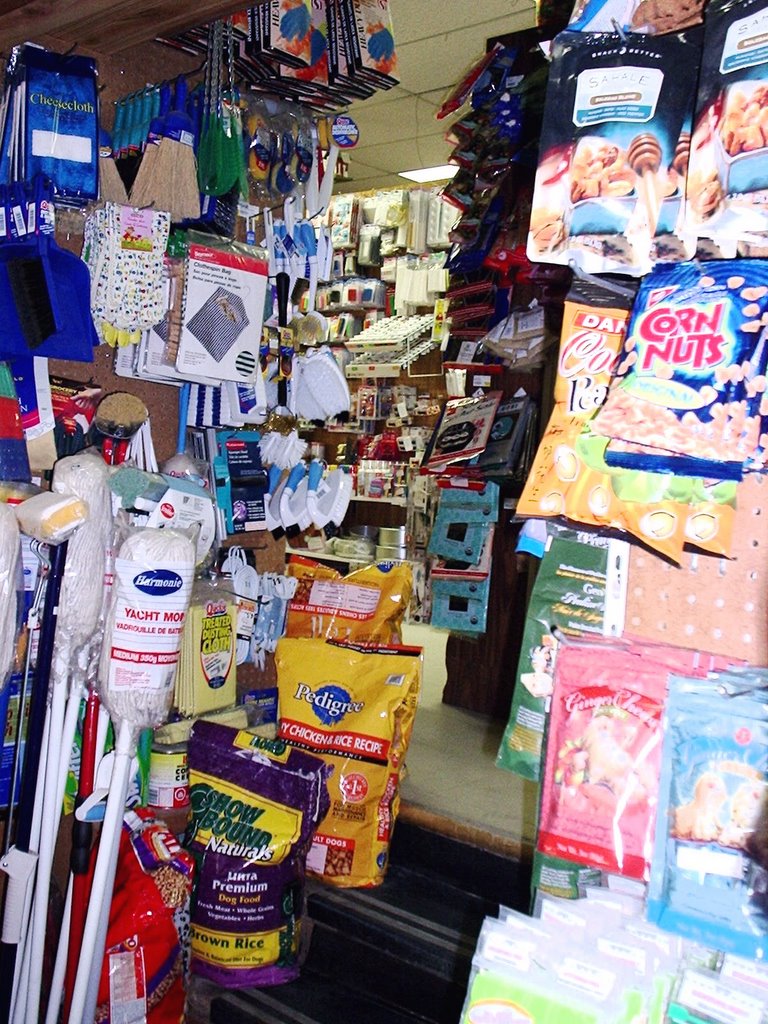 It's so chock full of stuff that it's hard to get a picture because you can't get far enough away from stacks of products to take one. See what I mean? Dog food, several styles of floor mops, garden gloves, rubber gloves, cheesecloth, irons, extension cords, brooms and whisk brooms, not to mention the corn nuts and candy. And if you go up the stairs to the far shelf in the photo, you can get fabric dye and a few other craft and sewing supplies.
 From the photo at the top of this post, you'd think the building was the ordinary boxy sort, wouldn't you? It's not. It's almost triangle shaped, with one side only a few feet wide, as the photo shows. The shape of the building, I'm guessing, was determined long ago by the shape of the lot it occupied. So the outside of the store is almost--but not quite--as interesting as what's inside.
The clerk could not find [them] in the store, but she checked in the back and came back with two pails, shovels attached, and at a reasonable price. And it was a small price to pay indeed for the joy of two boys who gloried that day in digging in the sand and catching minnows in their new buckets.
can attest to the wide range of goods. The only thing I was ever asked for while working there that I could not find for the customer was.....bulk nails. We had nails, just not in bulk.He goes on:
Most interesting item on the shelf was electric socks.Hey, you know you've got something good going when your customers give you free advertising.
An item I still by there exclusively is Tempura Batter. (Can't find it anywhere else.)
Also, if you think that the store is interesting, you should see the back room(s).
Labels: Yukon life
posted by Rebecca Stark at 2/20/2006 08:39:00 AM
Labels: Yukon life
posted by Rebecca Stark at 2/02/2006 08:16:00 AM
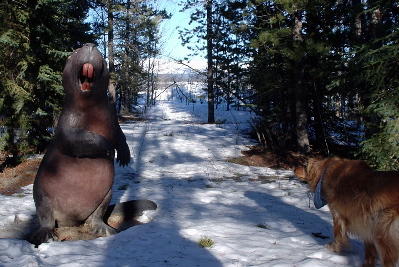
[u]nlike modern beavers with their short smooth-surfaced cutting teeth (incisors), giant beavers had cutting teeth up to 15 cm long with prominently-ridged outer surfaces. Perhaps these strong enamel ridges would have acted as girders to support such long teeth. Although experts on ancient life (paleontologists) do not agree on the function of the cutting teeth, it seems that they could have acted as both wood cutters and gougers.Girders and cutters and gougers? No wonder my dog's scared of them. But those of us who can read know that there's no reason to be scared as long as you're not a vegetable. Some scientists believe that even trees were probably more than those beavers could chew and they were content to eat "coarse swamp vegetation such as roots and cattails."
Labels: Yukon life
posted by Rebecca Stark at 7/27/2005 10:55:00 AM
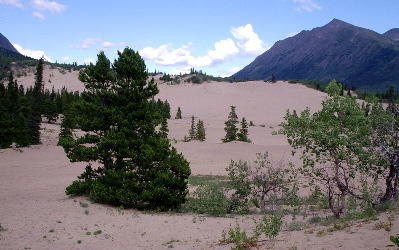
Labels: Yukon life
posted by Rebecca Stark at 7/25/2005 09:02:00 AM
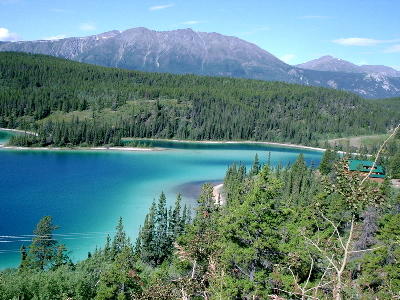
Labels: Yukon life
posted by Rebecca Stark at 7/22/2005 06:51:00 PM
Labels: Yukon life
posted by Rebecca Stark at 6/30/2005 11:53:00 AM

Labels: Yukon life
posted by Rebecca Stark at 4/14/2005 10:20:00 AM
He claims the Yukon government offered him a job heading the communications department for the Ministry of Economic Development.
But Sa Tan admits when he applied for the job he used his old name. He claims when the government found out he'd legally changed that name to Sa Tan, they withdrew the job offer....
Sa Tan's asking the court to rule that four government employees have defamed him by denying the job offer was ever made. He says they've publicly suggested he's a liar, making it tough for him to get another government job.
Labels: Yukon life
posted by Rebecca Stark at 4/08/2005 01:58:00 PM

Labels: Yukon life
posted by Rebecca Stark at 3/18/2005 06:38:00 PM

At the Top of the World, in the Yukon-Alaskan Interior, an epic event takes place every year that few people from "down south" have experienced. Covering 1000 miles between Whitehorse, Yukon Territory and Fairbanks, Alaska during the depths of the Arctic winter, the Yukon Quest is the "Toughest Sled Dog Race in the World."Look at the smiles. Those dogs are just happy to be running.
The Yukon Quest Trail follows historic Gold Rush and Mail Delivery routes from the turn of the 20th Century. Once a travel highway of the Northern frontier, the trail comes alive each February with the breath of hundreds of sled dogs. Teams of one human 'musher' and 14 canine athletes, travel for two weeks, racing through some of the last pristine wilderness remaining in North America.
Labels: Yukon life
posted by Rebecca Stark at 2/13/2005 03:06:00 PM
"The goshawk is really taking each and every last pigeon, and right now in downtown Whitehorse there are five pigeons left," says Cameron Eckert, a bird biologist with the Yukon government.
"About four have been seen in the past few weeks, there were five about a month ago."
Labels: Yukon life
posted by Rebecca Stark at 1/20/2005 01:26:00 PM


The Library:
Biblical Commentary
from the best of the Christian Blogosphere
Women4God Blogs Aggregator
Warnie Award Recipients Aggregator
Blogs4God Apologia Aggregator
Blogdom of God Aggregator
League of Reformed Blogs Aggregator
Atom Feed


